# What is DeSyn Protocol

[DeSyn Protocol](https://www.desyn.io) is a decentralized liquidity infrastructure on Web3, empowering investors, projects and security companies to invest, build and manage all together.

<figure><img src="https://245932585-files.gitbook.io/~/files/v0/b/gitbook-x-prod.appspot.com/o/spaces%2FZfmVzvFfhPc46NKqgV40%2Fuploads%2FdDszS6ULdbd0223obBdL%2Fimage.png?alt=media&amp;token=ca968a9a-c2a4-4916-af7b-f66cf6c88ab4" alt=""><figcaption></figcaption></figure>

DeSyn Protocol has received investments from the following investors. We are particularly excited about the future of our partnership with these funds, as we share a common vision and are committed to achieving our goals together. With this investment, we are well-positioned to continue developing our cutting-edge technology and expanding our market presence.&#x20;

<figure><img src="https://245932585-files.gitbook.io/~/files/v0/b/gitbook-x-prod.appspot.com/o/spaces%2FZfmVzvFfhPc46NKqgV40%2Fuploads%2FPLSbjgesWR62Xy5mFC2m%2Fimage.png?alt=media&amp;token=36d81f86-b4d5-4af8-b844-1e4f57715bb1" alt=""><figcaption></figcaption></figure>


# Whitepaper V2.2

{% file src="/files/zT7ovLY3fF8xOERWzSfj" %}


# Roadmap

## Q1:

* Launch multiple products on various chains including Hemi, Mint, Sonic and Berachain

## Q2:

* Launch multiples products on various chains
* Design the Security Model v1

## Q3:

* Launch multiples products on various chains
* Launch the Security Model v1

## Q4:

* Launch multiples products on various chains&#x20;
* Launch the Security Model v2
* Design the Security Model v3


# FAQ

<figure><img src="https://desyn.zendesk.com/hc/article_attachments/6477944427535" alt=""><figcaption></figcaption></figure>

### **1. If I issue shares for my assets in an open-end ETF, then do these assets go under the full control of the creator?** <a href="#ddd6" id="ddd6"></a>

With an open-end ETF, you have control over your assets. You can issue and redeem them whenever you like. Assets are stored on the blockchain, and no one owns or controls your funds, not even DeSyn Protocol, because of its decentralized behavior.

### **2. Why am I unable to connect my wallet via an Android/mobile browser?** <a href="#e813" id="e813"></a>

Sorry, right now we don’t have a mobile version, so we recommend you use the website version to trade.

### **3. How many fees do I need to pay?** <a href="#id-615b" id="id-615b"></a>

To issue or redeem a portfolio, you must pay gas, issuance, redemption, and management fees. The set limit for respective fees (except gas) should be from 0% to 10%, which the portfolio creators can set. So It’s up to the portfolio creators how much percentage (%) they are willing to charge within the above set range.

And if you want to create a portfolio, then you need to pay the gas fee only.

### **4. What does (20%) platform commission mean?** <a href="#id-4763" id="id-4763"></a>

The 20% **Platform Commissions** are set based on the **Issue Fees, Redemption Fees, and Management Fees**, NOT your total funds. *For example: If the Issue Fee and Redemption Fee are set at 1%, then the platform commission will be 0.2% of that amount.*

### **5. Is there any way to deeply participate in the DeSyn Protocol?** <a href="#id-3295" id="id-3295"></a>

Be a part of something big! DeSyn’s Global Ambassador Program is your opportunity to help promote the growth of the DeSyn ecosystem and take part in shaping the #WEB3 finance industry. There are a lot of ways to join us, such as Transaction Ambassador, Technical Ambassador, Promotion Ambassador, and Business Ambassador.

> Sign up now to join our community of ambassadors:\
> <https://forms.gle/1aW5dAKtTKe3m4JS9>

### **6. Why is the gas fee so high sometimes?** <a href="#e603" id="e603"></a>

Creating an ETF entails creating a contract of your own. If Ethereum traffic is high, the gas fee may be expensive. We suggest trying it when Ethereum traffic is low.

If you have any additional questions, you are welcome to either ask in DeSyn Communities (you can find links below)

<br>


# Product Introduction


# Roles

**1.2.1 Investor**

➢ Investors can obtain shares by purchasing them on centralized exchanges (CEX) and decentralized exchanges (DEX).

➢  Also, they can create a pool and generate shares through the protocol.

➢  Investors retain full custody of the assets, the pools are secured by DeSyn smart contracts, and the pool managers only have management rights and cannot transfer the assets.

**1.2.2 Pool Manager**

➢ The pool manager is the manager of the asset management product, and Desyn allows one asset management product to have multiple managers.

➢ The pool manager mainly need to maintain and rebalance the proportion of various assets in the asset management protocol to meet their asset management strategy.

➢ The pool manager can provide their product information to customers who meet their requirements, which can be individuals, institutional investors, and DAOs.

➢ The pool manager can reasonably distribute fund income and motivate core members related to asset management products to achieve smooth product fundraising and sustain profitability.

**1.2.3 Developer**

➢ Developers will continue to optimize and iterate the DeSyn Protocol so that it can meet the more complex needs of pool managers and investors.

➢ Developers will integrate the contracts of various third parties in a timely manner, and disclose detailed documents to outside. We support and encourage customers to use our basic protocols to build various products.

**1.2.4 Fundraising Partner**

➢ Fundraising partner assist in raising money for products by promoting products that meet their expectations.

➢ Everyone can be a DeSyn fundraising partner. As long as he finds a product he likes and forwards it, the protocol will calculate its raised contribution and associated commission according to the policy set by the pool manager, and secure the fundraising partner's income via smart contracts.


# Service

**1.3.1 Open-end Product**

➢ It is very simple to use the DeSyn platform to create an open-end product. The product liquidity created by the open-end structure is super-awesome and investors can join and withdraw at any time.

➢ It is especially suitable for index products:

➢ **Sector index, constructed based on the category of digital assets.**

➢ **Popular index, constructed based on popularity of the market towards certain concepts**

➢ **High-performing indexes, constructed based on the index of high-performing or well-managed digital assets.**

➢Indicator index, constructed based on some specific indicators.

**View the video description of the creation process of \[**[**Open-end Product: asset management products**](https://www.youtube.com/watch?v=L8GVLhJGdXY)**]**

**1.3.2 Closed-end Product**

➢ Closed-end products are suitable for professional individuals and teams who pursue supreme profits.

➢You can set a special fundraising period for the product roadshow, and pool shares can be circulated and transferred on decentralized exchanges (DEX).

➢ Due to the operation period is closed for money in and out, managers are less affected by the fluctuation of pool scale.

**1.3.3 DIY product**

➢ **DIY Products are suitable for complex strategies and very professional individuals and asset management institutions.**

➢ **You can refer to DeSyn's interface documentation or communicate with DeSyn's team to issue some products that designs various DeFi strategies and have complex strategy calculations.**

➢ **The DeSyn team supports the development of personalized strategy products so that portfolio managers can better meet their trading strategies.**

➢ **For example: leveraged staking ETH, etc**

➢ **If necessary, please \[**[**join our community**](https://desyn.zendesk.com/hc/en-us/articles/6180967327503-Join-the-DeSyn-Community)**] and contact us through official channels.**

**1.3.4 On-chain commission sharing System**

➢ Reasonable income distribution will serve a good incentive for the market and management team. Using it in the right way will help the management team to expand their business and obtain more income.

➢ We support managers to establish a fully decentralized and flexible revenue distribution rule on chain through the DeSyn Protocol.

➢ Pool managers can reasonably distribute the main income (issuance fee, redemption fee, management fee, and performance fee) of the product according to the contribution of fundraising partners and investment experts to the pool.

<br>


# Fee

When the portfolio shares are minted, the manager can set up the fees.  All the fees will be automatically calculated and collected by the smart contract. Once set, it cannot be changed during the duration of the product. The fee type and calculation method are as follows.

**1.4.1 Issuance fee**

➢ The fee charged when minting shares.

➢ The protocol will charge the fee according to the size of minted shares and the fee rate set by the pool manager (0≤fee rate≤10%).

➢ Issuance fee=Issuance fee rate\*Size of issuing shares

**1.4.2 Redemption Fee**

➢ Redemption fee is charged at the time of redemption (open-end) or liquidation of the pool (close-end).

➢ The protocol will charge the fee according to the fee rate set by the pool manager (0≤fee rate≤10%) and then according to the size of shares at the time of redemption or liquidation.

➢ Redemption fee = redemption rate \* redemption/liquidation of size of shares

&#x20;**1.4.3 Management Fee**

➢ The management fee is charged daily according to the size of assets, and the pool manager withdraws it into his wallet according to his own needs.

➢The protocol charges it at a fee rate set by the pool manager (0≤ rate ≤10%) and calculated based on the size of the asset of the snapshot of the day when the pool withdraws the fees, averaged to the daily.

➢ Management fee (day)=management fee rate\* size of asset at the end of the day\*/365 ( the day: when the pool withdraws the fees)

**1.4.4 Performance fee**

➢ Performance fees are generally found in closed-end products, set up to motivate pool managers, and are generally collected at liquidation.

➢ Performance fee is to distribute the profits of pool management. The pool manager can agree with investors through a protocol on the performance fee rate, which will be charged according to the profits at the time of liquidation.

➢Performance fee = profit of asset management products \* performance fee rate


# How to Issue & Redeem A Pool?

There are two methods to help you discover the perfect product for your needs.

### **List Search - New Product**

<figure><img src="https://245932585-files.gitbook.io/~/files/v0/b/gitbook-x-prod.appspot.com/o/spaces%2FZfmVzvFfhPc46NKqgV40%2Fuploads%2F0FH0I1KAJt0e1G82Qu6f%2Fimage.png?alt=media&amp;token=d4d37ebb-4a3f-4875-a0ac-d1c2ebd9bfca" alt=""><figcaption></figcaption></figure>

We have integrated our latest release pool into this list, you can click \[Market] to access the list and retrieve products by sorting the indicators.

### **Issuance and Redemption** <a href="#h_01h9t484pqmztenv98wsqnkgf0" id="h_01h9t484pqmztenv98wsqnkgf0"></a>

The DeSyn Protocol supports investors to mint and burn shares.&#x20;

**In an open-end product, this operation can be done anytime and anywhere;**&#x20;

**In a closed-end product, it can be done according to the initial setup of the pool：**

○ **Issue**

You can purchase by doing the following actions

<figure><img src="https://245932585-files.gitbook.io/~/files/v0/b/gitbook-x-prod.appspot.com/o/spaces%2FZfmVzvFfhPc46NKqgV40%2Fuploads%2FjstnZYEKmZPTvU4v5Rls%2Fimage.png?alt=media&amp;token=059ca958-4572-4108-b2f3-2cf45c0964fb" alt=""><figcaption></figcaption></figure>

○ **Redeem**

After the management period, you can sell by the following actions.&#x20;

{% hint style="info" %}
Please Note: If all the share tokens in the pool are withdrawn, the pool will automatically become inactive and can no longer be used.
{% endhint %}

<figure><img src="https://245932585-files.gitbook.io/~/files/v0/b/gitbook-x-prod.appspot.com/o/spaces%2FZfmVzvFfhPc46NKqgV40%2Fuploads%2F34cnTbyhyiHYbXnEvP0N%2Fimage.png?alt=media&amp;token=209582e3-4026-4f97-8e4e-4d6790615fba" alt=""><figcaption></figcaption></figure>

### **Pool Monitoring** <a href="#h_01h9t484pqtjzgg8f12qehgdx0" id="h_01h9t484pqtjzgg8f12qehgdx0"></a>

After connecting your wallet, you can see the assets issued and redeemed and the detailed transaction history through the dashboard.

![](https://desyn.zendesk.com/hc/article_attachments/6192840189711)


# How to Manage a Pool

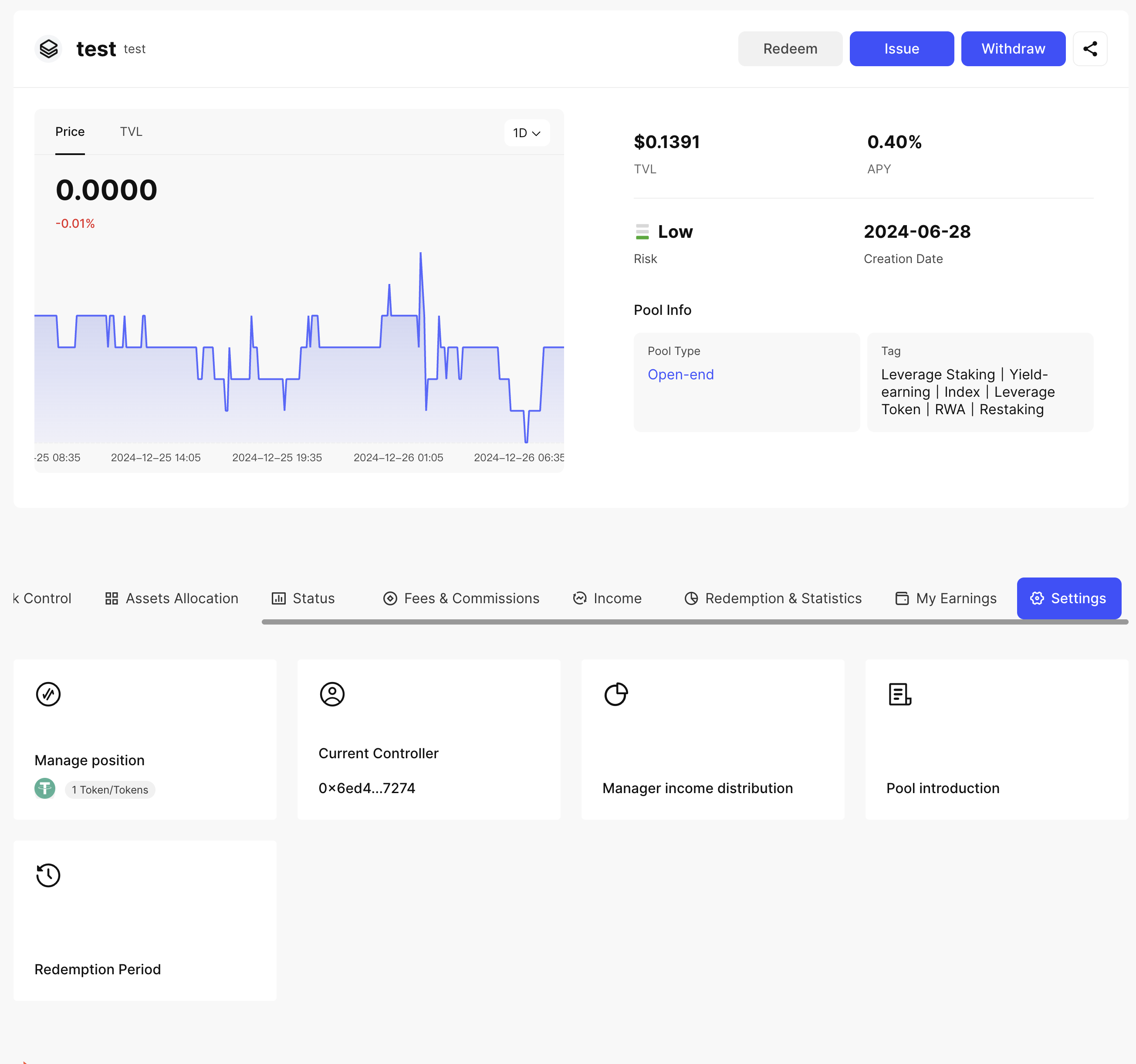
**You can manage and maintain your pool by accessing the settings function on the pool details page**

<figure><img src="https://245932585-files.gitbook.io/~/files/v0/b/gitbook-x-prod.appspot.com/o/spaces%2FZfmVzvFfhPc46NKqgV40%2Fuploads%2FkzBYCOL6jYePH7Ybzie8%2Fimage.png?alt=media&amp;token=6c8c684d-78f9-4a38-8c6b-ce8d06a493da" alt=""><figcaption></figcaption></figure>

### **1. Position Adjustment**

<figure><img src="https://lh3.googleusercontent.com/ft_uj345UjEg0mkmFwldoQJfnyPc-_9iQFUZae7BBwT0rd9ryat1YeRVNEwPWRPP8R3J4daLuliY9fOcUiUNvI5fo28DTD_Uem2x7AatPGR3_jtHg7RbPtj9_3M1UPtra-fKLOyiZc-2o9o352UA0So" alt=""><figcaption></figcaption></figure>

This function only allows owners and managers to have access to manage the composition of the pool's asset allocation.

### **2. Transferring Ownership**

![](https://lh3.googleusercontent.com/vcSYIbDrfi43hSJd1_t0gjUy5wLiuz1jK57QBeTQVdfPvPj3Jlsdy2tABx-wXoDnihYAc3lHPb6ND_wNSs51k3AG8J3y5imI61X0ejiVqC5hzp-6ViSQozBvAwEZWInBkY7nayPon56PeS3On2VRWhE)

You can transfer the investment pool's management authority (the highest authority) to another address. Once the operation is successful, the replaced address will lose the management authority of the portfolio, so please operate with caution.

### **3. Manager’s Income Distribution**

![](https://lh4.googleusercontent.com/P9lmgZBMoE0TAfhrRh-Hw1AKOdpLIqLy7-rSb8Nz2EgE7G5Gnu1W_mQngErhWhXAzP5Cgqf3WDmnEbujm7Cn7AVABzHOP0BrDPAA3iIQNQORVecvuRjgVDMqe4rh-uR7vJX-ZZ1w_sk7sO4feTTZsyA)

You can use this function to grant manager authority to other addresses and give combined benefits. Once you add or delete the addresses, the management fee income will be distributed instantly.

### **4. Pool Introduction**

You can write a compelling description for the pool so that investors can better acquaint themselves with you and your team. Note: This function can only be added once for the time being, and modifications are not allowed once completed, so please proceed with caution.

### **5. Turn on Performance Statistics**

![](https://lh3.googleusercontent.com/A9lrwjAtBLqNu2vn5CyB6wXUKBxG11z5BFFhGiTwhRBkdHdWqpyuxrLK3uFZtNFXHCm42P-9Ppa4E12IVrbt7wY_XUzTbBCL_r2e_sXhnKvntem-dOCSbUc7bIoqDPhJghmiuwks9Kz5xRiT9h0bUNM)

This function is exclusive to the Closed-end products, and Open-end products do not have this function.

This function mainly calculates the performance fee for Closed-end products. We use this function to lock in the initial size of the pool assets.

According to the fundraising status, the manager can turn on the performance statistics and start operating the pool, even if the fundraising period has not ended.

Once the performance statistics are enabled, the pool will automatically enter the management period.

T Day refers to the fundraising deadline. Managers can open performance statistics at any time before T+3 Day, and everyone can help the pool open performance statistics on T+2\~3 Day.

After T+3 Day, the pool will no longer be able to turn on performance statistics, which means that the pool will not be able to count and allocate performance fees.

Therefore, this operation is an important sign of the formal establishment and operation of the pool. Managers who manage Closed-end pool must pay attention to them and operate them in a timely manner to avoid negligence.

### **6. Closing Performance Statistics**

Closing performance statistics are also a feature exclusive to Closed-end portfolio products, where the manager can terminate performance statistics at the end of the management period provided that the manager/investor has turned on performance statistics.

The contract will calculate the return based on the portfolio asset size at the time of opening and terminating performance statistics and complete the distribution of performance fees according to the contract.

The operation deadline is T day. On T+1 day, only the manager can terminate the performance statistics. After T+1 day, if the manager has not terminated the performance statistics, everyone can operate this function, and the earliest data submitted for confirmation shall prevail.

### **7. Whitelist Function**

In order to better comply with relevant regulations and risk control, we offer two whitelist systems.

**Investor whitelist:** The owner can set who is allowed to invest in this product. If an address is added to the whitelist that allows to invest and later be removed, it means the address cannot invest new shares in the future, but the redemption of historical shares is not affected.

**Token Whitelist:** The owner can set which tokens the managers of this portfolio can trade, and these tokens need to be selected from the list of tokens allowed by the platform.

For more details, please refer to&#x20;

{% content-ref url="/pages/S1RAkc2WNEUVv4T8xLud" %}
[Whitelist Rules Description](/mechanism/product-introduction/whitelist-rules-description)
{% endcontent-ref %}

### **8. Termination of a Pool**

**At present, there is no concept of manual termination/dismission for both Open-end and Closed-end products. Managers, investors, and fundraising partners can retrieve their own assets according to the rules of the protocol until the asset in the pool is 0.**


# How to become a fundraising partner？

<figure><img src="https://245932585-files.gitbook.io/~/files/v0/b/gitbook-x-prod.appspot.com/o/spaces%2FZfmVzvFfhPc46NKqgV40%2Fuploads%2FjH6q7X0W7f56WU5XBXfL%2Fimage.png?alt=media&amp;token=2ccdba43-a6ce-443d-8805-ab282010e45a" alt=""><figcaption></figcaption></figure>

DeSyn Platform has a transparent commission-sharing mechanism, based on: the “Share to Earn" principle.

For anyone who shares a pool link after connecting their wallet, the forwarding link will contain their unique ID. If the pool has specified commission terms and an investor invests using this link, the smart contract will automatically compute and allocate the rewards from the "rewards pool."&#x20;

No more actions are needed.

We have created a detailed document to explain the mechanism of how the pool income and incentive policy works, for details Please refer to:

{% embed url="<https://desynprotocol.gitbook.io/docs/referrals/exchange-proxy>" %}

### **How to withdraw fundraising incentives？**

Fundraising incentives can be viewed and withdrawn by fundraising partners in \[User Center - My Commission].

<figure><img src="https://245932585-files.gitbook.io/~/files/v0/b/gitbook-x-prod.appspot.com/o/spaces%2FZfmVzvFfhPc46NKqgV40%2Fuploads%2FUv5R8aBaWpJ5viiVOzIf%2Fimage.png?alt=media&amp;token=326b8cff-ce0f-415a-ba88-3ebd578be6f5" alt=""><figcaption></figcaption></figure>


# Whitelist Rules Description

The DeSyn platform offers two types of whitelist mechanisms that guarantee compliance and pool security.

### **1) Investor whitelist**

* The pool owner can determine which investors are allowed to invest in a specific pool. This feature supports various compliance operations within the financial sector.
* A pool owner can enable an “Investor whitelist” option in \[Advanced Settings] when creating a pool, as shown below.

<figure><img src="https://245932585-files.gitbook.io/~/files/v0/b/gitbook-x-prod.appspot.com/o/spaces%2FZfmVzvFfhPc46NKqgV40%2Fuploads%2FCXoOFkPpHhbvP9iSD2ww%2Fimage.png?alt=media&amp;token=45514b35-b682-4154-868f-77c150588731" alt=""><figcaption></figcaption></figure>

* After enabling the Investor Whitelist while creating the pool, you need to add the investors in \[Pool Detail Page → Settings→Investor Whitelist], otherwise the portfolio can’t be traded.

![mceclip1.png](https://desyn.zendesk.com/hc/article_attachments/6355176221199)

### **2) Token Whitelist**&#x20;

* The “Investment Token Whitelist,” is mainly used to determine the investment scope of the pool. This function mainly controls the risk of the pool by limiting the investment tokens that can be invested.
* The Investment Token Whitelist on the DeSyn platform implements a two-level whitelist mechanism, the DeSyn community will form a wide-area list of investment tokens based on the various data of these tokens in each market, which we call the first-level whitelist, and the DeSyn community owns the right to adjust this first-level whitelist.
* Pool owners can build their own pool Token whitelist to restrict investment tokens. We call this whitelist a secondary whitelist.
* The secondary whitelist can only be set once at the time of issuance, once set, it cannot be modified. If the pool owner doesn’t enable token whitelist, the scope of the first-level whitelist will be used as the limit by default.
* Pool owners can enable the “Token Whitelist” option in \[Advanced Settings] when creating a pool, as follows:

<figure><img src="https://245932585-files.gitbook.io/~/files/v0/b/gitbook-x-prod.appspot.com/o/spaces%2FZfmVzvFfhPc46NKqgV40%2Fuploads%2FpxR3LneSbTW7HEI9zSWP%2Fimage.png?alt=media&amp;token=b1e721db-bc6d-4aad-b92a-b457d2dfdee2" alt=""><figcaption></figcaption></figure>

* After enabling the Token Whitelist while creating the pool, you need to add the Tokens in \[Pool Detail Page → Settings→Investment Token Whitelist], otherwise, the pool can’t be traded.

<figure><img src="https://desyn.zendesk.com/hc/article_attachments/6355204557327" alt=""><figcaption></figcaption></figure>

<figure><img src="https://desyn.zendesk.com/hc/article_attachments/6355178398351" alt=""><figcaption></figcaption></figure>


# Token Whitelist

The current whitelist of investment targets is as follows:

<table><thead><tr><th valign="top">Chain</th><th valign="top">Symbol</th><th valign="top">Contract</th></tr></thead><tbody><tr><td valign="top">Merlin</td><td valign="top">M-ordi</td><td valign="top">0x0726523Eba12EdaD467c55a962842Ef358865559</td></tr><tr><td valign="top">Merlin</td><td valign="top">$ETH</td><td valign="top">0x2449170ef127CA2F4ffd71860F4834aF1fcdC55D</td></tr><tr><td valign="top">Merlin</td><td valign="top">SolvBTC</td><td valign="top">0x41d9036454be47d3745a823c4aacd0e29cfb0f71</td></tr><tr><td valign="top">Merlin</td><td valign="top">MERL</td><td valign="top">0x5c46bFF4B38dc1EAE09C5BAc65872a1D8bc87378</td></tr><tr><td valign="top">Merlin</td><td valign="top">M-USDC</td><td valign="top">0x6b4eCAdA640F1B30dBdB68f77821A03A5f282EbE</td></tr><tr><td valign="top">Merlin</td><td valign="top">M-USDT</td><td valign="top">0x967aEC3276b63c5E2262da9641DB9dbeBB07dC0d</td></tr><tr><td valign="top">Merlin</td><td valign="top">M-STONE</td><td valign="top">0xB5d8b1e73c79483d7750C5b8DF8db45A0d24e2cf</td></tr><tr><td valign="top">Merlin</td><td valign="top">M-BTC</td><td valign="top">0xB880fd278198bd590252621d4CD071b1842E9Bcd</td></tr><tr><td valign="top">Merlin</td><td valign="top">BTC</td><td valign="top">0xEeeeeEeeeEeEeeEeEeEeeEEEeeeeEeeeeeeeEEeE</td></tr><tr><td valign="top">Merlin</td><td valign="top">WBTC</td><td valign="top">0xF6D226f9Dc15d9bB51182815b320D3fBE324e1bA</td></tr><tr><td valign="top">zklink</td><td valign="top">USDC</td><td valign="top">0x1a1A3b2ff016332e866787B311fcB63928464509</td></tr><tr><td valign="top">zklink</td><td valign="top">USDT</td><td valign="top">0x2F8A25ac62179B31D62D7F80884AE57464699059</td></tr><tr><td valign="top">zklink</td><td valign="top">WETH</td><td valign="top">0x8280a4e7D5B3B658ec4580d3Bc30f5e50454F169</td></tr><tr><td valign="top">zklink</td><td valign="top">nETH</td><td valign="top">0x93D79E21a68f66D79449fbF4fB4Ed025ABAcc2F6</td></tr><tr><td valign="top">zklink</td><td valign="top">ZKL</td><td valign="top">0xC967dabf591B1f4B86CFc74996EAD065867aF19E</td></tr><tr><td valign="top">zklink</td><td valign="top">WBTC</td><td valign="top">0xDa4AaEd3A53962c83B35697Cd138cc6df43aF71f</td></tr><tr><td valign="top">zklink</td><td valign="top">ETH</td><td valign="top">0xEeeeeEeeeEeEeeEeEeEeeEEEeeeeEeeeeeeeEEeE</td></tr><tr><td valign="top">zklink</td><td valign="top">DAI</td><td valign="top">0xF573fA04A73d5AC442F3DEa8741317fEaA3cDeab</td></tr><tr><td valign="top">zklink</td><td valign="top">rnETH</td><td valign="top">0xfa70fD01EbD5aa64f31E5D3575C444919C79275E</td></tr><tr><td valign="top">Mode</td><td valign="top">weETH.mode</td><td valign="top">0x04C0599Ae5A44757c0af6F9eC3b93da8976c150A</td></tr><tr><td valign="top">Mode</td><td valign="top">ankrETH</td><td valign="top">0x12D8CE035c5DE3Ce39B1fDD4C1d5a745EAbA3b8C</td></tr><tr><td valign="top">Mode</td><td valign="top">ION</td><td valign="top">0x18470019bF0E94611f15852F7e93cf5D65BC34CA</td></tr><tr><td valign="top">Mode</td><td valign="top">ezETH</td><td valign="top">0x2416092f143378750bb29b79eD961ab195CcEea5</td></tr><tr><td valign="top">Mode</td><td valign="top">ionUSDC</td><td valign="top">0x2BE717340023C9e14C1Bb12cb3ecBcfd3c3fB038</td></tr><tr><td valign="top">Mode</td><td valign="top">WETH</td><td valign="top">0x4200000000000000000000000000000000000006</td></tr><tr><td valign="top">Mode</td><td valign="top">SolvBTC</td><td valign="top">0x541FD749419CA806a8bc7da8ac23D346f2dF8B77</td></tr><tr><td valign="top">Mode</td><td valign="top">M-BTC</td><td valign="top">0x59889b7021243dB5B1e065385F918316cD90D46c</td></tr><tr><td valign="top">Mode</td><td valign="top">inETH</td><td valign="top">0x5A7a183B6B44Dc4EC2E3d2eF43F98C5152b1d76d</td></tr><tr><td valign="top">Mode</td><td valign="top">uniBTC</td><td valign="top">0x6B2a01A5f79dEb4c2f3c0eDa7b01DF456FbD726a</td></tr><tr><td valign="top">Mode</td><td valign="top">STONE</td><td valign="top">0x80137510979822322193FC997d400D5A6C747bf7</td></tr><tr><td valign="top">Mode</td><td valign="top">ionUSDT</td><td valign="top">0x94812F2eEa03A49869f95e1b5868C6f3206ee3D3</td></tr><tr><td valign="top">Mode</td><td valign="top">pxETH</td><td valign="top">0x9E0d7D79735e1c63333128149c7b616a0dC0bBDb</td></tr><tr><td valign="top">Mode</td><td valign="top">WBTC</td><td valign="top">0xcdd475325d6f564d27247d1dddbb0dac6fa0a5cf</td></tr><tr><td valign="top">Mode</td><td valign="top">uBTC</td><td valign="top">0xd0d1b59CA62cE194E882455Fd36632d6277b192a</td></tr><tr><td valign="top">Mode</td><td valign="top">USDC</td><td valign="top">0xd988097fb8612cc24eec14542bc03424c656005f</td></tr><tr><td valign="top">Mode</td><td valign="top">ANKR</td><td valign="top">0xDF474B7109b73b7D57926d43598D5934131136b2</td></tr><tr><td valign="top">Mode</td><td valign="top">oBTC</td><td valign="top">0xe3C0FF176eF92FC225096C6d1788cCB818808b35</td></tr><tr><td valign="top">Mode</td><td valign="top">wrsETH</td><td valign="top">0xe7903B1F75C534Dd8159b313d92cDCfbC62cB3Cd</td></tr><tr><td valign="top">Mode</td><td valign="top">ETH</td><td valign="top">0xEeeeeEeeeEeEeeEeEeEeeEEEeeeeEeeeeeeeEEeE</td></tr><tr><td valign="top">Mode</td><td valign="top">USDT</td><td valign="top">0xf0f161fda2712db8b566946122a5af183995e2ed</td></tr><tr><td valign="top">bitlayer</td><td valign="top">RATS</td><td valign="top">0x0d922f10d86243ceff899f15571f51951e8b20f6</td></tr><tr><td valign="top">bitlayer</td><td valign="top">SATOSHI</td><td valign="top">0x54cc66725493afea5045fe3a32edd620becd0d77</td></tr><tr><td valign="top">bitlayer</td><td valign="top">wstETH</td><td valign="top">0x5659b4c62897fa36c05780cd96c2d5c0a5602488</td></tr><tr><td valign="top">bitlayer</td><td valign="top">SATS</td><td valign="top">0x8dae8b60f16a10edfac1714394688e006ff369fa</td></tr><tr><td valign="top">bitlayer</td><td valign="top">DOG</td><td valign="top">0x90a75e214bda302196cb8279c1331320579e3d91</td></tr><tr><td valign="top">bitlayer</td><td valign="top">USDC</td><td valign="top">0x9827431e8b77e87c9894bd50b055d6be56be0030</td></tr><tr><td valign="top">bitlayer</td><td valign="top">bfBTC</td><td valign="top">0xcdfb58c8c859cb3f62ebe9cf2767f9e036c7fb15</td></tr><tr><td valign="top">bitlayer</td><td valign="top">ORDI</td><td valign="top">0xde9f57a5b8844ebf607eceffaa2505bb961701a4</td></tr><tr><td valign="top">bitlayer</td><td valign="top">CORE</td><td valign="top">0xdf31d68e3debcc373656356ddaac1243e0515437</td></tr><tr><td valign="top">bitlayer</td><td valign="top">BTC</td><td valign="top">0xEeeeeEeeeEeEeeEeEeEeeEEEeeeeEeeeeeeeEEeE</td></tr><tr><td valign="top">bitlayer</td><td valign="top">ETH</td><td valign="top">0xef63d4e178b3180beec9b0e143e0f37f4c93f4c2</td></tr><tr><td valign="top">bitlayer</td><td valign="top">stBTC</td><td valign="top">0xf6718b2701d4a6498ef77d7c152b2137ab28b8a3</td></tr><tr><td valign="top">bitlayer</td><td valign="top">USDT</td><td valign="top">0xfe9f969faf8ad72a83b761138bf25de87eff9dd2</td></tr><tr><td valign="top">bitlayer</td><td valign="top">WBTC</td><td valign="top">0xfF204e2681A6fA0e2C3FaDe68a1B28fb90E4Fc5F</td></tr><tr><td valign="top">ethereum</td><td valign="top">uniBTC</td><td valign="top">0x004E9C3EF86bc1ca1f0bB5C7662861Ee93350568</td></tr><tr><td valign="top">ethereum</td><td valign="top">1INCH</td><td valign="top">0x111111111117dc0aa78b770fa6a738034120c302</td></tr><tr><td valign="top">ethereum</td><td valign="top">BIT</td><td valign="top">0x1a4b46696b2bb4794eb3d4c26f1c55f9170fa4c5</td></tr><tr><td valign="top">ethereum</td><td valign="top">UNI</td><td valign="top">0x1f9840a85d5af5bf1d1762f925bdaddc4201f984</td></tr><tr><td valign="top">ethereum</td><td valign="top">WBTC</td><td valign="top">0x2260fac5e5542a773aa44fbcfedf7c193bc2c599</td></tr><tr><td valign="top">ethereum</td><td valign="top">mswETH</td><td valign="top">0x32bd822d615A3658A68b6fDD30c2fcb2C996D678</td></tr><tr><td valign="top">ethereum</td><td valign="top">FXS</td><td valign="top">0x3432b6a60d23ca0dfca7761b7ab56459d9c964d0</td></tr><tr><td valign="top">ethereum</td><td valign="top">eETH</td><td valign="top">0x35fA164735182de50811E8e2E824cFb9B6118ac2</td></tr><tr><td valign="top">ethereum</td><td valign="top">SAND</td><td valign="top">0x3845badade8e6dff049820680d1f14bd3903a5d0</td></tr><tr><td valign="top">ethereum</td><td valign="top">WBNB</td><td valign="top">0x418d75f65a02b3d53b2418fb8e1fe493759c7605</td></tr><tr><td valign="top">ethereum</td><td valign="top">DOGE</td><td valign="top">0x4206931337dc273a630d328da6441786bfad668f</td></tr><tr><td valign="top">ethereum</td><td valign="top">mstETH</td><td valign="top">0x49446a0874197839d15395b908328a74ccc96bc0</td></tr><tr><td valign="top">ethereum</td><td valign="top">APE</td><td valign="top">0x4d224452801aced8b2f0aebe155379bb5d594381</td></tr><tr><td valign="top">ethereum</td><td valign="top">cSTONE</td><td valign="top">0x4d831e22F062b5327dFdB15f0b6a5dF20E2E3dD0</td></tr><tr><td valign="top">ethereum</td><td valign="top">FTM</td><td valign="top">0x4e15361fd6b4bb609fa63c81a2be19d873717870</td></tr><tr><td valign="top">ethereum</td><td valign="top">BUSD</td><td valign="top">0x4fabb145d64652a948d72533023f6e7a623c7c53</td></tr><tr><td valign="top">ethereum</td><td valign="top">LINK</td><td valign="top">0x514910771af9ca656af840dff83e8264ecf986ca</td></tr><tr><td valign="top">ethereum</td><td valign="top">STBT</td><td valign="top">0x530824da86689c9c17cdc2871ff29b058345b44a</td></tr><tr><td valign="top">ethereum</td><td valign="top">DAI</td><td valign="top">0x6b175474e89094c44da98b954eedeac495271d0f</td></tr><tr><td valign="top">ethereum</td><td valign="top">SUSHI</td><td valign="top">0x6b3595068778dd592e39a122f4f5a5cf09c90fe2</td></tr><tr><td valign="top">ethereum</td><td valign="top">XSGD</td><td valign="top">0x70e8de73ce538da2beed35d14187f6959a8eca96</td></tr><tr><td valign="top">ethereum</td><td valign="top">STONE</td><td valign="top">0x7122985656e38BDC0302Db86685bb972b145bD3C</td></tr><tr><td valign="top">ethereum</td><td valign="top">MATIC</td><td valign="top">0x7d1afa7b718fb893db30a3abc0cfc608aacfebb0</td></tr><tr><td valign="top">ethereum</td><td valign="top">AAVE</td><td valign="top">0x7fc66500c84a76ad7e9c93437bfc5ac33e2ddae9</td></tr><tr><td valign="top">ethereum</td><td valign="top">FRAX</td><td valign="top">0x853d955acef822db058eb8505911ed77f175b99e</td></tr><tr><td valign="top">ethereum</td><td valign="top">mmETH</td><td valign="top">0x8a053350ca5f9352a16ded26ab333e2d251dad7c</td></tr><tr><td valign="top">ethereum</td><td valign="top">DYDX</td><td valign="top">0x92d6c1e31e14520e676a687f0a93788b716beff5</td></tr><tr><td valign="top">ethereum</td><td valign="top">SHIB</td><td valign="top">0x95ad61b0a150d79219dcf64e1e6cc01f0b64c4ce</td></tr><tr><td valign="top">ethereum</td><td valign="top">MKR</td><td valign="top">0x9f8f72aa9304c8b593d555f12ef6589cc3a579a2</td></tr><tr><td valign="top">ethereum</td><td valign="top">USDC</td><td valign="top">0xa0b86991c6218b36c1d19d4a2e9eb0ce3606eb48</td></tr><tr><td valign="top">ethereum</td><td valign="top">rsETH</td><td valign="top">0xA1290d69c65A6Fe4DF752f95823fae25cB99e5A7</td></tr><tr><td valign="top">ethereum</td><td valign="top">wBETH</td><td valign="top">0xa2E3356610840701BDf5611a53974510Ae27E2e1</td></tr><tr><td valign="top">ethereum</td><td valign="top">rETH</td><td valign="top">0xae78736Cd615f374D3085123A210448E74Fc6393</td></tr><tr><td valign="top">ethereum</td><td valign="top">stETH</td><td valign="top">0xae7ab96520de3a18e5e111b5eaab095312d7fe84</td></tr><tr><td valign="top">ethereum</td><td valign="top">cbETH</td><td valign="top">0xbe9895146f7af43049ca1c1ae358b0541ea49704</td></tr><tr><td valign="top">ethereum</td><td valign="top">ezETH</td><td valign="top">0xbf5495Efe5DB9ce00f80364C8B423567e58d2110</td></tr><tr><td valign="top">ethereum</td><td valign="top">WETH</td><td valign="top">0xc02aaa39b223fe8d0a0e5c4f27ead9083c756cc2</td></tr><tr><td valign="top">ethereum</td><td valign="top">ENS</td><td valign="top">0xc18360217d8f7ab5e7c516566761ea12ce7f9d72</td></tr><tr><td valign="top">ethereum</td><td valign="top">weETH</td><td valign="top">0xCd5fE23C85820F7B72D0926FC9b05b43E359b7ee</td></tr><tr><td valign="top">ethereum</td><td valign="top">CRV</td><td valign="top">0xd533a949740bb3306d119cc777fa900ba034cd52</td></tr><tr><td valign="top">ethereum</td><td valign="top">pufETH</td><td valign="top">0xd9a442856c234a39a81a089c06451ebaa4306a72</td></tr><tr><td valign="top">ethereum</td><td valign="top">USDT</td><td valign="top">0xdac17f958d2ee523a2206206994597c13d831ec7</td></tr><tr><td valign="top">ethereum</td><td valign="top">mwBETH</td><td valign="top">0xE46a5E19B19711332e33F33c2DB3eA143e86Bc10</td></tr><tr><td valign="top">ethereum</td><td valign="top">uniETH</td><td valign="top">0xF1376bceF0f78459C0Ed0ba5ddce976F1ddF51F4</td></tr><tr><td valign="top">ethereum</td><td valign="top">rswETH</td><td valign="top">0xFAe103DC9cf190eD75350761e95403b7b8aFa6c0</td></tr><tr><td valign="top">arbitrum</td><td valign="top">PENDLE</td><td valign="top">0x0c880f6761f1af8d9aa9c466984b80dab9a8c9e8</td></tr><tr><td valign="top">arbitrum</td><td valign="top">GNS</td><td valign="top">0x18c11fd286c5ec11c3b683caa813b77f5163a122</td></tr><tr><td valign="top">arbitrum</td><td valign="top">RDNT</td><td valign="top">0x3082CC23568eA640225c2467653dB90e9250AaA0</td></tr><tr><td valign="top">arbitrum</td><td valign="top">weETH</td><td valign="top">0x35751007a407ca6FEFfE80b3cB397736D2cf4dbe</td></tr><tr><td valign="top">arbitrum</td><td valign="top">SolvBTC</td><td valign="top">0x3647c54c4c2C65bC7a2D63c0Da2809B399DBBDC0</td></tr><tr><td valign="top">arbitrum</td><td valign="top">rsETH</td><td valign="top">0x4186BFC76E2E237523CBC30FD220FE055156b41F</td></tr><tr><td valign="top">arbitrum</td><td valign="top">MAGIC</td><td valign="top">0x539bde0d7dbd336b79148aa742883198bbf60342</td></tr><tr><td valign="top">arbitrum</td><td valign="top">WETH</td><td valign="top">0x82aF49447D8a07e3bd95BD0d56f35241523fBab1</td></tr><tr><td valign="top">arbitrum</td><td valign="top">FRAX</td><td valign="top">0x853d955acef822db058eb8505911ed77f175b99e</td></tr><tr><td valign="top">arbitrum</td><td valign="top">ARB</td><td valign="top">0x912CE59144191C1204E64559FE8253a0e49E6548</td></tr><tr><td valign="top">arbitrum</td><td valign="top">DAI</td><td valign="top">0xDA10009cBd5D07dd0CeCc66161FC93D7c9000da1</td></tr><tr><td valign="top">arbitrum</td><td valign="top">LINK</td><td valign="top">0xf97f4df75117a78c1a5a0dbb814af92458539fb4</td></tr><tr><td valign="top">arbitrum</td><td valign="top">UNI</td><td valign="top">0xfa7f8980b0f1e64a2062791cc3b0871572f1f7f0</td></tr><tr><td valign="top">arbitrum</td><td valign="top">GMX</td><td valign="top">0xfc5a1a6eb076a2c7ad06ed22c90d7e710e35ad0a</td></tr><tr><td valign="top">arbitrum</td><td valign="top">USDT</td><td valign="top">0xFd086bC7CD5C481DCC9C85ebE478A1C0b69FCbb9</td></tr><tr><td valign="top">scroll</td><td valign="top">USDC</td><td valign="top">0x06eFdBFf2a14a7c8E15944D1F4A48F9F95F663A4</td></tr><tr><td valign="top">scroll</td><td valign="top">WETH</td><td valign="top">0x5300000000000000000000000000000000000004</td></tr><tr><td valign="top">scroll</td><td valign="top">DAI</td><td valign="top">0xcA77eB3fEFe3725Dc33bccB54eDEFc3D9f764f97</td></tr><tr><td valign="top">scroll</td><td valign="top">ETH</td><td valign="top">0xEeeeeEeeeEeEeeEeEeEeeEEEeeeeEeeeeeeeEEeE</td></tr><tr><td valign="top">scroll</td><td valign="top">USDT</td><td valign="top">0xf55BEC9cafDbE8730f096Aa55dad6D22d44099Df</td></tr><tr><td valign="top">linea</td><td valign="top">USDC</td><td valign="top">0x176211869cA2b568f2A7D4EE941E073a821EE1ff</td></tr><tr><td valign="top">linea</td><td valign="top">DAI</td><td valign="top">0x4AF15ec2A0BD43Db75dd04E62FAA3B8EF36b00d5</td></tr><tr><td valign="top">linea</td><td valign="top">USDT</td><td valign="top">0xA219439258ca9da29E9Cc4cE5596924745e12B93</td></tr><tr><td valign="top">linea</td><td valign="top">WETH</td><td valign="top">0xe5D7C2a44FfDDf6b295A15c148167daaAf5Cf34f</td></tr><tr><td valign="top">linea</td><td valign="top">ETH</td><td valign="top">0xEeeeeEeeeEeEeeEeEeEeeEEEeeeeEeeeeeeeEEeE</td></tr><tr><td valign="top">ailayer</td><td valign="top">iUSD</td><td valign="top">0x0A3BB08b3a15A19b4De82F8AcFc862606FB69A2D</td></tr><tr><td valign="top">ailayer</td><td valign="top">ABTC</td><td valign="top">0x1470a4831F76954686BfB4dE8180F7469EA8dE6F</td></tr><tr><td valign="top">ailayer</td><td valign="top">BFBTC</td><td valign="top">0xC2236204768456B21eAfEf0d232Ba1FccCe59823</td></tr><tr><td valign="top">ailayer</td><td valign="top">bBTC</td><td valign="top">0xEAa3C2fa77c306592750C9220a8f52DA8A849Ede</td></tr><tr><td valign="top">ailayer</td><td valign="top">BTC</td><td valign="top">0xEeeeeEeeeEeEeeEeEeEeeEEEeeeeEeeeeeeeEEeE</td></tr><tr><td valign="top">core</td><td valign="top">oBTC</td><td valign="top">0x000734cF9E469BAd78c8EC1b0dEeD83D0A03C1F8</td></tr><tr><td valign="top">core</td><td valign="top">pumpBTC</td><td valign="top">0x5a2aa871954eBdf89b1547e75d032598356caad5</td></tr><tr><td valign="top">core</td><td valign="top">SolvBTC.b</td><td valign="top">0x5B1Fb849f1F76217246B8AAAC053b5C7b15b7dc3</td></tr><tr><td valign="top">core</td><td valign="top">uBTC</td><td valign="top">0x782e2b85fda9a8224C17B191fc5DE1e085a962b2</td></tr><tr><td valign="top">core</td><td valign="top">COREBTC</td><td valign="top">0x8034ab88c3512246bf7894f57c834dddbd1de01f</td></tr><tr><td valign="top">core</td><td valign="top">USDT</td><td valign="top">0x900101d06a7426441ae63e9ab3b9b0f63be145f1</td></tr><tr><td valign="top">core</td><td valign="top">SolvBTC.CORE</td><td valign="top">0x9410e8052Bc661041e5cB27fDf7d9e9e842af2aa</td></tr><tr><td valign="top">core</td><td valign="top">USDT</td><td valign="top">0xA219439258ca9da29E9Cc4cE5596924745e12B93</td></tr><tr><td valign="top">core</td><td valign="top">uBTC</td><td valign="top">0xbB4A26A053B217bb28766a4eD4b062c3B4De58ce</td></tr><tr><td valign="top">core</td><td valign="top">SolvBTC.m</td><td valign="top">0xe04d21d999FaEDf1e72AdE6629e20A11a1ed14FA</td></tr><tr><td valign="top">core</td><td valign="top">WCORE</td><td valign="top">0xe5D7C2a44FfDDf6b295A15c148167daaAf5Cf34f</td></tr><tr><td valign="top">core</td><td valign="top">CORE</td><td valign="top">0xEeeeeEeeeEeEeeEeEeEeeEEEeeeeEeeeeeeeEEeE</td></tr><tr><td valign="top">b2</td><td valign="top">WBTC</td><td valign="top">0x4200000000000000000000000000000000000006</td></tr><tr><td valign="top">b2</td><td valign="top">USDT</td><td valign="top">0x681202351a488040Fa4FdCc24188AfB582c9DD62</td></tr><tr><td valign="top">b2</td><td valign="top">uBTC</td><td valign="top">0x796e4D53067FF374B89b2Ac101ce0c1f72ccaAc2</td></tr><tr><td valign="top">b2</td><td valign="top">uniBTC</td><td valign="top">0x93919784C523f39CACaa98Ee0a9d96c3F32b593e</td></tr><tr><td valign="top">b2</td><td valign="top">BTC</td><td valign="top">0xEeeeeEeeeEeEeeEeEeEeeEEEeeeeEeeeeeeeEEeE</td></tr><tr><td valign="top">hemi</td><td valign="top">WETH</td><td valign="top">0x4200000000000000000000000000000000000006</td></tr><tr><td valign="top">hemi</td><td valign="top">bfBTC</td><td valign="top">0x623F2774d9f27B59bc6b954544487532CE79d9DF</td></tr><tr><td valign="top">hemi</td><td valign="top">enzoBTC</td><td valign="top">0x6A9A65B84843F5fD4aC9a0471C4fc11AFfFBce4a</td></tr><tr><td valign="top">hemi</td><td valign="top">uBTC</td><td valign="top">0x78E26E8b953C7c78A58d69d8B9A91745C2BbB258</td></tr><tr><td valign="top">hemi</td><td valign="top">iBTC</td><td valign="top">0x8154Aaf094c2f03Ad550B6890E1d4264B5DdaD9A</td></tr><tr><td valign="top">hemi</td><td valign="top">M-BTC</td><td valign="top">0x9BFA177621119e64CecbEabE184ab9993E2ef727</td></tr><tr><td valign="top">hemi</td><td valign="top">BTC</td><td valign="top">0xEeeeeEeeeEeEeeEeEeEeeEEEeeeeEeeeeeeeEEeE</td></tr><tr><td valign="top">hemi</td><td valign="top">pumpBTC</td><td valign="top">0xF469fBD2abcd6B9de8E169d128226C0Fc90a012e</td></tr><tr><td valign="top">bnb</td><td valign="top">WBTC</td><td valign="top">0x0555E30da8f98308EdB960aa94C0Db47230d2B9c</td></tr><tr><td valign="top">bnb</td><td valign="top">ETH</td><td valign="top">0x2170Ed0880ac9A755fd29B2688956BD959F933F8</td></tr><tr><td valign="top">bnb</td><td valign="top">USDT</td><td valign="top">0x55d398326f99059fF775485246999027B3197955</td></tr><tr><td valign="top">bnb</td><td valign="top">enzoBTC</td><td valign="top">0x6A9A65B84843F5fD4aC9a0471C4fc11AFfFBce4a</td></tr><tr><td valign="top">bnb</td><td valign="top">ynBTCk</td><td valign="top">0x78839cE14a8213779128Ee4da6D75E1326606A56</td></tr><tr><td valign="top">bnb</td><td valign="top">WBNB</td><td valign="top">0xbb4CdB9CBd36B01bD1cBaEBF2De08d9173bc095c</td></tr><tr><td valign="top">exsat</td><td valign="top">WBTC</td><td valign="top">0x4aa4365da82ACD46e378A6f3c92a863f3e763d34</td></tr><tr><td valign="top">exsat</td><td valign="top">iBTC</td><td valign="top">0x8154Aaf094c2f03Ad550B6890E1d4264B5DdaD9A</td></tr><tr><td valign="top">exsat</td><td valign="top">USDT</td><td valign="top">0xA7366BE06B2867a207c0C4F37481fF7B0cE62D87</td></tr><tr><td valign="top">exsat</td><td valign="top">esBTC</td><td valign="top">0xaFB068838136358CFa6B54BEa580B86DF70BBA7f</td></tr><tr><td valign="top">exsat</td><td valign="top">BTC</td><td valign="top">0xEeeeeEeeeEeEeeEeEeEeeEEEeeeeEeeeeeeeEEeE</td></tr></tbody></table>


# DeSyn's Contracts Overview

We have always believed that liquidity is important area for the crypto world. As one of the pioneers in this field, our advocated SDT Model, which is an innovative decentralized asset management approach, entirely based on smart contract.<br>

As aforementioned, we have detailed the main features of the SDT model. Our goal in this part is to dive deeper into the model to highlight, 1) the characteristics of each of our contracts in the SDT model, 2) the decentralized management and open-source planning of the contracts, and 3) the audit status of our contracts.

1. **Introduction to contracts**
2. **Decentralized management and open-source planning of contracts**
3. **Contract auditing**

## Introduction to contracts

As of August 30, 2023, we have a total of 23 contracts, which can be mainly divided into the following categories:

<figure><img src="https://lh7-us.googleusercontent.com/nKN5ssiu07b-wK1dlcBJeM3To0SNglYav91UPyG2RAa62SrCy_eoteeq0CviLb0hHuzWM1yGsg05F_0Bx6ewzlhBSEMh4gWmmRh-ZLk3M6hVIIgu3ieG8bBmJbQkOtidmYo2_o6VdEDQuGkZ0iu71g" alt=""><figcaption></figcaption></figure>

### 1) Factory

The Factory contract is one of the core control contracts in the protocol. Blabs roles can use this contract to add token whitelists, set trusted modules, change oracles, Vault, and UserVault addresses, pause the protocol, and modify Pool bytecode. Users can use this contract to create new pools and Blabs roles can also be modified.

### 2) CRPFactory

The CRP Factory contract creates Configurable Rights Pools. The contract has a Blabs role, which is set to the creator’s address (EOA) at contract creation and cannot be modified. Blabs roles can perform sensitive operations such as modifying UserVault addresses and CRP bytecode.

### 3）DSProxyFactory

The DSProxy Factory contract creates DSProxy contracts for users. Users can use DSProxy contracts to perform Action operations. It is generally called by the ProxyRegistry contract, but users can also call it directly to create contracts.

### 4）UserVault

UserVault contract pays commissions to recommenders, the funds come from part of the Vault contract fees and do not involve user funds. The contract has an owner role, the owner role can modify sensitive parameters such as userVault and management\_portion in the contract, and can also transfer funds in the contract through claimToken and claimEther.

### 5） Vault

The Vault contract is used to handle the issuance, redemption, management, and other fees of the protocol and does not involve user funds. The contract has an owner role, which can modify sensitive parameters such as vaultAddresscrpFactory in the contract, and can also transfer funds through claimToken and claimEther contracts.

### 6） LiquidityPool&#x20;

The LiquidityPool contract is one of the core contracts that manages the Pool, and users' assets are stored in this contract. Theoretically, when the pool officially starts operation, its controller should be the CRP contract and cannot be changed. Joining/exiting/ adjustment operations are all performed through CRP. So in theory, you only need to monitor whether the funds in this contract are sent to reduce significantly.

### 7)  Actions

The Actions contract is a logic implementation contract, which is called by the user through the DSProxy contract DELEGATECALL. The user performs pool creation/issuance/redemption/management operations through the Actions contract. This contract is only for the convenience of user operation, and users can also implement the operation of pool by themselves.

### 8） DesynSafeMath

This contract provides a library for safe mathematical operations for the protocol; this is a static library and does not involve any data storage.

### 9） ProxyRegistry

The ProxyRegistry contract provides users with an entrance to create DSProxy; users can initiate Actions through DSProxy.

### 10） RightsManager

The RightsManager contract is used by the ConfigurableRightsPool contract to manage whether to enable user and token whitelisting. It is only set by the creator when the contract is initialized and cannot be changed subsequently. Therefore no monitoring is required.

### 11 ）ConfigurableRightsPool

The ConfigurableRightsPool contract is one of the core contracts that manages the pool. Users can add and remove liquidity through this contract. The owner/admin can be designated by the creator, and can only perform the contract's token whitelist, fee collection, and new pool creation operations. There is no problem with excessive authority and the contract does not retain funds, so no monitoring is required.

### 12） Multicall

Multicall is generally used by the front end to perform specified operations quickly and efficiently on the chain. It only provides an external calling function and does not involve any data storage.

### 13） LeverageStaking Pool and LeverageStaking

The Leverage Staking contract implements the 3x leverage staking strategy for ETH. The process of cyclically increasing leverage is implemented through increaseLever, and batch operations can use the interface with batchIncreaseLever. The process of reducing leverage is implemented through decreaseLever, and batchDecreaseLever is used for batch operations. This contract must be added to the whitelist module of the platform before performing trading operations (staking, lending, etc.). the operation of adding a whitelist module requires a multi-signature account on the platform to perform multi-signature operations.

### 14) 3x ETH Staking Pool and LeverageStaking Production

Similar to No.17, both have the same ETH cyclic staking strategy and officially operate contract products.

### 15)  dSTBT-Test and TBill

U.S. bond product contracts, dSTBT-Test is a pool created by fund managers to raise and manage assets. The TBill contract module implements the management of U.S. bond products, mainly to achieve docking with Matrixdock, and the swap interface implements the mint and redeem processes of STBT.

The TBill contract module must be added to the whitelist operation module to perform the swap operation. The operation of adding the whitelist requires the multi-signature account of the platform to perform the multi-sign operation;

### 16) dSTBT production and TBill Production

Same as No.19, they are all U.S. bond product contracts and are officially operational contract products;

### 18) Oracle

* Changes to price source configurations,
* Adjustments to asset conversion logic,
* Admin address modifications.

The Oracle contract is managed by an admin role that can update pricing parameters and token mappings. To ensure integrity and trust in the system, the following aspects must be closely monitored:

1. **Unified Yield and Fee Calculation**

   To ensure consistency and fairness, the protocol calculates yields, performance fees, and referral commissions by converting all values into a **common base currency**, such as USDT, BTC, or ETH. Oracle provides the real-time prices required for these conversions, supporting standardized reporting across various strategies and products.
2. **Multi-Currency Support in Subscriptions and Redemptions**

   When users subscribe to or redeem from a pool using different tokens, the Oracle ensures accurate conversion between these tokens and the pool’s base asset. This allows the protocol to support a wide range of tokens in investment operations while maintaining precise value matching.

There are **two key scenarios** where the Oracle is essential:

The **Oracle** contract provides real-time price feeds for the protocol using **RedStone** as the exclusive and primary data source. It plays a critical role in ensuring accurate, secure, and consistent asset valuation across the protocol.

### 19) DTBT

No direct changes unless further clarification is needed.

These contracts are mainly divided into the following 3 categories:

**1. Core Protocol Contracts**

Factory, CRPFactory, DSProxyFactory, UserVault, Vault, and LiquidityPool mainly involve factory contracts and asset custody-related contracts.

**2. Protocol Operation Contracts**

Actions, ProxyRegistry, Multicall, ConfigurableRightsPool, RightsManager, and SmartPoolManager mainly implement user operations, permissions, and other operation-type functionalities.

**3. Strategy Module Contracts**

Include Leverage Staking and STBT contracts, including 3x ETH Staking, LeverageStaking, TBill, etc., mainly implementing strategies like 3X Ethereum staking and short-term Treasury bills.

**4. Support Contracts**

Support contracts act as foundational components that assist the protocol in calculations, security, and system interactions.

This includes:

* **Oracle**: Provides price feeds exclusively from **RedStone**, enabling **two critical functions** within the protocol:
  1. Converting yields, performance fees, and commissions into **a unified base asset** (e.g., USDT, BTC, ETH) for standardized financial reporting;
  2. **Facilitating multi-currency conversions** during user subscription and redemption processes to support diversified asset inputs with accurate real-time exchange rates.
* **DesynSafeMath**: A static utility library for secure mathematical operations. It does not store data or contain any business logic but ensures overflow/underflow safety throughout the protocol.

While support contracts do not hold user funds, they are **vital for the accuracy, transparency, and smooth functioning** of the entire system.

### Decentralized management of contracts and open-source plan

From the classification and introduction of the above contracts, we have a better understanding of the purpose of each contract.

In this section, we will discuss the decentralized management of contracts and our open-source plan.<br>

First, we firmly adhere to the decentralized philosophy. In practice, we will gradually complete the full decentralization of the project.

Next, the current protocol management address is the multi-signature wallet address 0xf8770931fC94d05Ab4982d06bd6572BDF520E174, a 3/5 multi-signature contract account with five private keys, where blockchain-related operations require confirmation from three private keys.<br>

Lastly, our current open-source plan is:

* Phase One (0 to 1): In the first phase, since the product has newly entered the market, considering many functionalities still need adjustments and upgrades, we will retain the upgrade rights for these contracts. However, the core protocol contracts are the most important, have the highest security requirements involving asset custody and safety, and will be open-sourced during this phase.
* Phase Two (1 to 10): In the second phase, as some functionalities get stabilized and no longer need upgrades, such as protocol operation contracts, which generally connect the entire protocol process and permissions, optimizing the experience for fund managers and users, but do not hold assets in custody, these will be open-sourced in the second phase.
* Phase Three (10 to 100): In the third phase, as the protocol started operating steadily, and different strategies attained stability, at this time, strategy module contracts related to fund investment strategies will be open-sourced.

Lastly, support contracts can be open-sourced at any time.

### Contract Auditing

Audit is a vital aspect of our security. Currently, every line of our contract code is being audited by two agencies. In the future, we will add more agencies to conduct audits. For more information, please check the following link:

{% content-ref url="/pages/kQDBlmeOfWDiHWLwChRK" %}
[Audit Report](/security/audit-report)
{% endcontent-ref %}

Thank you,

DeSyn Team

<br>


# Copy of DeSyn's Contracts Overview

We have always believed that liquidity is important area for the crypto world. As one of the pioneers in this field, our advocated SDT Model, which is an innovative decentralized asset management approach, entirely based on smart contract.<br>

As aforementioned, we have detailed the main features of the SDT model. Our goal in this part is to dive deeper into the model to highlight, 1) the characteristics of each of our contracts in the SDT model, 2) the decentralized management and open-source planning of the contracts, and 3) the audit status of our contracts.

1. **Introduction to contracts**
2. **Decentralized management and open-source planning of contracts**
3. **Contract auditing**

## Introduction to contracts

As of August 30, 2023, we have a total of 23 contracts, which can be mainly divided into the following categories:

<figure><img src="https://lh7-us.googleusercontent.com/nKN5ssiu07b-wK1dlcBJeM3To0SNglYav91UPyG2RAa62SrCy_eoteeq0CviLb0hHuzWM1yGsg05F_0Bx6ewzlhBSEMh4gWmmRh-ZLk3M6hVIIgu3ieG8bBmJbQkOtidmYo2_o6VdEDQuGkZ0iu71g" alt=""><figcaption></figcaption></figure>

### 1) Factory

The Factory contract is one of the core control contracts in the protocol. Blabs roles can use this contract to add token whitelists, set trusted modules, change oracles, Vault, and UserVault addresses, pause the protocol, and modify Pool bytecode. Users can use this contract to create new pools and Blabs roles can also be modified.

### 2) CRPFactory

The CRP Factory contract creates Configurable Rights Pools. The contract has a Blabs role, which is set to the creator’s address (EOA) at contract creation and cannot be modified. Blabs roles can perform sensitive operations such as modifying UserVault addresses and CRP bytecode.

### 3）DSProxyFactory

The DSProxy Factory contract creates DSProxy contracts for users. Users can use DSProxy contracts to perform Action operations. It is generally called by the ProxyRegistry contract, but users can also call it directly to create contracts.

### 4） DesynChainlinkOracle

The DesynChainlinkOracle contract provides price feeds from Chainlink and self-priced services for the protocol. There is an admin role, which can modify price feeds and self-priced prices. Therefore, it is necessary to monitor modifications to price feeds, whether self-priced prices match the current market and modifications to admin addresses.

### 5） UserVault

UserVault contract pays commissions to recommenders, the funds come from part of the Vault contract fees and do not involve user funds. The contract has an owner role, the owner role can modify sensitive parameters such as userVault and management\_portion in the contract, and can also transfer funds in the contract through claimToken and claimEther.

### 6） Vault

The Vault contract is used to handle the issuance, redemption, management, and other fees of the protocol and does not involve user funds. The contract has an owner role, which can modify sensitive parameters such as vaultAddresscrpFactory in the contract, and can also transfer funds through claimToken and claimEther contracts.

### 7） LiquidityPool&#x20;

The LiquidityPool contract is one of the core contracts that manages the Pool, and users' assets are stored in this contract. Theoretically, when the pool officially starts operation, its controller should be the CRP contract and cannot be changed. Joining/exiting/ adjustment operations are all performed through CRP. So in theory, you only need to monitor whether the funds in this contract are sent to reduce significantly.

### 8)  Actions

The Actions contract is a logic implementation contract, which is called by the user through the DSProxy contract DELEGATECALL. The user performs pool creation/issuance/redemption/management operations through the Actions contract. This contract is only for the convenience of user operation, and users can also implement the operation of pool by themselves.

### 9） DesynSafeMath

This contract provides a library for safe mathematical operations for the protocol; this is a static library and does not involve any data storage.

### 10） ProxyRegistry

The ProxyRegistry contract provides users with an entrance to create DSProxy; users can initiate Actions through DSProxy.

### 11） RightsManager

The RightsManager contract is used by the ConfigurableRightsPool contract to manage whether to enable user and token whitelisting. It is only set by the creator when the contract is initialized and cannot be changed subsequently. Therefore no monitoring is required.

### 12 ）ConfigurableRightsPool

The ConfigurableRightsPool contract is one of the core contracts that manages the pool. Users can add and remove liquidity through this contract. The owner/admin can be designated by the creator, and can only perform the contract's token whitelist, fee collection, and new pool creation operations. There is no problem with excessive authority and the contract does not retain funds, so no monitoring is required.

### 13） Multicall

Multicall is generally used by the front end to perform specified operations quickly and efficiently on the chain. It only provides an external calling function and does not involve any data storage.

### 14） DesynChainlinkOracle

The DesynChainlinkOracle contract provides the protocol with price feed sources and self-feeding services from Chainlink. There is an admin role, which modifies the price feed source and self-feed price.<br>

### 15） SmartPoolManager

The SmartPoolManager contract is called DELEGATECALL by ConfigurableRightsPool, which is a library used by CRP to manage user creation/issuance/redemption pools, fee collection, and fund transfers.

### 16） Oracle

The Oracle contract provides the protocol with price feeds from Uniswap Pair. Its owner is a fixed EOA address. Token price feeds and time-weighted periods can be added through the setNewTokenInfo and setPERIOD functions respectively.

### 17） LeverageStaking Pool and LeverageStaking

The Leverage Staking contract implements the 3x leverage staking strategy for ETH. The process of cyclically increasing leverage is implemented through increaseLever, and batch operations can use the interface with batchIncreaseLever. The process of reducing leverage is implemented through decreaseLever, and batchDecreaseLever is used for batch operations. This contract must be added to the whitelist module of the platform before performing trading operations (staking, lending, etc.). the operation of adding a whitelist module requires a multi-signature account on the platform to perform multi-signature operations.

### 18) 3x ETH Staking Pool and LeverageStaking Production

Similar to No.17, both have the same ETH cyclic staking strategy and officially operate contract products.

### 19)  dSTBT-Test and TBill

U.S. bond product contracts, dSTBT-Test is a pool created by fund managers to raise and manage assets. The TBill contract module implements the management of U.S. bond products, mainly to achieve docking with Matrixdock, and the swap interface implements the mint and redeem processes of STBT.

The TBill contract module must be added to the whitelist operation module to perform the swap operation. The operation of adding the whitelist requires the multi-signature account of the platform to perform the multi-sign operation;

### 20) dSTBT production and TBill Production

Same as No.19, they are all U.S. bond product contracts and are officially operational contract products;

### 21) DTBT

DTBT is an erc20 token, which is used in the transaction process of TBill contract and matrixdock (mint, redeem, etc.) to realize the record of asset transfer, form a complete record track, and enhance the product experience. It does not have actual asset value, so no need to worry about its safety;

These contracts are mainly divided into the following 3 categories:<br>

**1. Core Protocol Contracts**

Factory, CRPFactory, DSProxyFactory, UserVault, Vault, and LiquidityPool mainly involve factory contracts and asset custody-related contracts.<br>

**2. Protocol Operation Contracts**

Actions, ProxyRegistry, Multicall, ConfigurableRightsPool, RightsManager, and SmartPoolManager mainly implement user operations, permissions, and other operation-type functionalities.

**3. Strategy Module Contracts**

Include Leverage Staking and STBT contracts, including 3x ETH Staking, LeverageStaking, TBill, etc., mainly implementing strategies like 3X Ethereum staking and short-term Treasury bills.

**4. Support Contracts**

Mainly include DesynChainlinkOracle and Oracle, which primarily provide price feed services; and DesynSafeMath, which implements secure mathematical operations.<br>

### Decentralized management of contracts and open-source plan

From the classification and introduction of the above contracts, we have a better understanding of the purpose of each contract.

In this section, we will discuss the decentralized management of contracts and our open-source plan.<br>

First, we firmly adhere to the decentralized philosophy. In practice, we will gradually complete the full decentralization of the project.

Next, the current protocol management address is the multi-signature wallet address 0xf8770931fC94d05Ab4982d06bd6572BDF520E174, a 3/5 multi-signature contract account with five private keys, where blockchain-related operations require confirmation from three private keys.<br>

Lastly, our current open-source plan is:

* Phase One (0 to 1): In the first phase, since the product has newly entered the market, considering many functionalities still need adjustments and upgrades, we will retain the upgrade rights for these contracts. However, the core protocol contracts are the most important, have the highest security requirements involving asset custody and safety, and will be open-sourced during this phase.
* Phase Two (1 to 10): In the second phase, as some functionalities get stabilized and no longer need upgrades, such as protocol operation contracts, which generally connect the entire protocol process and permissions, optimizing the experience for fund managers and users, but do not hold assets in custody, these will be open-sourced in the second phase.
* Phase Three (10 to 100): In the third phase, as the protocol started operating steadily, and different strategies attained stability, at this time, strategy module contracts related to fund investment strategies will be open-sourced.

Lastly, support contracts can be open-sourced at any time.

### Contract Auditing

Audit is a vital aspect of our security. Currently, every line of our contract code is being audited by two agencies. In the future, we will add more agencies to conduct audits. For more information, please check the following link:

{% content-ref url="/pages/kQDBlmeOfWDiHWLwChRK" %}
[Audit Report](/security/audit-report)
{% endcontent-ref %}

Thank you,

DeSyn Team

<br>


# Key Features

Redefining Liquidity for Everyone

At DeSyn, we believe in making liquidity fair and accessible, transforming it into a common good that’s available to all—not a luxury reserved for the few.

<figure><img src="https://245932585-files.gitbook.io/~/files/v0/b/gitbook-x-prod.appspot.com/o/spaces%2FZfmVzvFfhPc46NKqgV40%2Fuploads%2Fqti5WkXXsvVMDboAGFCv%2Fimage.png?alt=media&amp;token=1f6927d6-00b3-4867-a32f-6b4b65e2bff6" alt=""><figcaption></figcaption></figure>


# Structured Liquidity Pools

Unlock optimized returns through cross-platform airdrops, high APR opportunities, and exclusive benefits.


# SLP Model

At DeSyn, we’ve identified the key to DeFi’s most profitable opportunities, and SLP Model is the cornerstone of this vision.

## The Power of SLP Model

The top way to make the most profits in DeFi is through SLP Model. Built on three core principles, SLP Model provides a secure, optimized, and comprehensive strategy for every investor:

1. **Secure Your Core Investment:** \
   Safety is our top priority. Your principal investment is protected as you explore the vast world of DeFi.
2. **Optimize Every Dollar on DeSyn:**\
   Maximize rewards from multiple DeFi platforms with minimal effort. Every dollar works harder for you, generating returns from a variety of sources.
3. **Seize Every Airdrop Opportunity:**\
   With our expert strategy, you’ll never miss out on potential airdrop gains across different ecosystems and chains.

<figure><img src="https://245932585-files.gitbook.io/~/files/v0/b/gitbook-x-prod.appspot.com/o/spaces%2FZfmVzvFfhPc46NKqgV40%2Fuploads%2F2y5Vrh65UvlSpre4ZsRI%2Fimage.png?alt=media&amp;token=5afb4cc0-f68b-4fb3-82c0-b6f9be35f368" alt=""><figcaption></figcaption></figure>

With each new chain or ecosystem that we partner with, DeSyn offers three distinct SLP Model products, allowing every type of investor to participate, regardless of risk tolerance.

## The Three SLP Model Products

### **Type 1: Simple Deposit Product**

This product is perfect for low-risk investors seeking stable and secure returns. By depositing assets into DeSyn's platform, you'll gain access to airdrops from DeSyn, new chains, and select partners.

This strategy excludes other DeFi protocols, ensuring a straightforward and low-risk approach while taking advantage of Layer-1 reward tokens (LRTs).

*<mark style="background-color:yellow;">Example: SolvBTC Restaking Fund I</mark>*

*<mark style="background-color:yellow;">A prime example of the Type 1 Simple Deposit Product is the SolvBTC Restaking Fund. In this product, investors begin by issuing M-BTC (Merlin Bitcoin), converted into SolvBTC through the Solv platform. The SolvBTC tokens are transferred to the Vault in DeSyn, where they are securely staked and restaked to generate returns.</mark>*

<figure><img src="https://lh7-rt.googleusercontent.com/docsz/AD_4nXdl9kVX0Vh_lE_A7nhf8OTNDbtLiiPfVkI1cridUe7O4xd-IXGP0OeVlJSsB7_hhSlQkzf5-op_4Hj5nLuatgEvbKUSLGhr_qU_QVmQYeynKXYhgIvs17aVK-VqPA4Odmx7HRw2coIZsU3yuJtHhNDS1c39?key=Dmj6QOg3f0srpZFKgoI7FA" alt=""><figcaption></figcaption></figure>

### **Type 2: Liquid Fund Product**

For investors with a medium risk tolerance, this product deploys assets across multiple DeFi protocols, such as lending platforms, decentralized exchanges (DEXs), and restaking opportunities. You'll benefit from airdrops from DeSyn, new ecosystems, and other DeFi protocols, maximizing the potential for rewards. The Liquid Fund Product incorporates advanced strategies, including auto-lending, leveraged staking, and ETH/BTC restaking, providing dynamic growth potential for those willing to engage in more complex DeFi opportunities.

\
*<mark style="background-color:yellow;">Example 1: Kelp DAO ETH Restaking Fund</mark>*

*<mark style="background-color:yellow;">An excellent example of a Type 2 product is the Kelp DAO ETH Restaking Fund. Investors deposit ETH, LSTs, or rsETH into DeSyn's vault. These assets are restaked across Kelp DAO and Eigenlayer, earning staking yields and airdrops from both platforms. The smart contract ensures secure operations, and the 3x points system maximizes returns, making this ideal for those seeking dynamic growth through multi-layered restaking.</mark>*

<figure><img src="https://lh7-rt.googleusercontent.com/docsz/AD_4nXe_h4h7rjVeVKXdlVGt4k6-F1Vef0fuTvVDWjjoAvmfrfvbFWj4t72BP7I5oSy7Ii4Jl-_kjOZYfyadhZQmlv8j88lRGj0tTPCAEbWBJrntFRUwsW2JoSVBVi8gbqQaPWEq50vJgLsXubO9etxbqLs8X0o?key=Dmj6QOg3f0srpZFKgoI7FA" alt=""><figcaption></figcaption></figure>

*<mark style="background-color:yellow;">Example 2: Open-end Decentralized Short-term U.S. Treasury Bill Token Fund</mark>*

*<mark style="background-color:yellow;">The Open-end Decentralized Short-term U.S. Treasury Bill Token Fund offers an excellent option for investors seeking stable returns with medium risk. Investors deposit oSTBT into a vault managed by Little Frog and Curve, providing stable returns through a decentralized liquidity pool. This fund offers exposure to U.S. Treasury Bills, balancing risk while delivering continuous returns and airdrops from DeSyn and Curve, which is ideal for those seeking short-term, low-risk investments.</mark>*

<figure><img src="https://lh7-rt.googleusercontent.com/docsz/AD_4nXevEGLadn9xlHbW4jKq1e8ffN8mNFSH2Suu2vJtul42ejqxwGHpRYEyxyeKUzKbZ_QdZ2ZfGMGdGO9Dzhmw34nQTBEnFDsCj1j6E-uTLxHTfr0mVIqv8NIAG2eFpLi3OBv1YZKIsoinh0z-Ot_Eu6pqsvgf?key=Dmj6QOg3f0srpZFKgoI7FA" alt=""><figcaption></figcaption></figure>

*<mark style="background-color:yellow;">Example 3: Semi Open-end 3x ETH Staking ETF</mark>*

*<mark style="background-color:yellow;">In the semi-open-end 3x ETH Staking ETF, using WETH, investors use a leveraged staking strategy through platforms like Lido, Curve, and AAVE. This fund maximizes returns through repeated staking and leveraging cycles, amplifying profits up to 3x. Managed by smart contracts, it's an excellent option for medium-risk investors looking for high growth potential.</mark>*

<figure><img src="https://lh7-rt.googleusercontent.com/docsz/AD_4nXdx3f_jNqN-jYXMDuiK2oQud3tS505D5ndaLRSzCjLGlDp2krpGTsp8B25KW14Lcb8CD4XE-2UeoQKwR3AcDCGsqM2jKR-jLUH6j9tATKwsOLEZsrGhNne_YT06D0xt3k6UXyqWfrVT3rOzqUKGFdl6KbHe?key=Dmj6QOg3f0srpZFKgoI7FA" alt=""><figcaption></figcaption></figure>

*<mark style="background-color:yellow;">Example 4: Open-end SSV Liquidity Restaking Fund</mark>*

*<mark style="background-color:yellow;">Investors deposit stETH into a vault interacting with SSV and Eigenlayer, generating staking profits and airdrops. This fund leverages node operators and further restakes on Eigenlayer, optimizing returns through multi-layered staking and airdrop strategies, perfect for Ethereum stakers aiming for enhanced yields.</mark>*

<figure><img src="https://lh7-rt.googleusercontent.com/docsz/AD_4nXcvoEDkQNgEVL4awrzVRDtmPLxBv9GNRMEKvyyQZ7G55MjOUh7RilsQzM3fMDDG0IgWtbhuwuscFnhTEsrMcAdCkorezOg-Ct6ttSeZmp_OsQgCwHcgbEzLZ1VY8zgpLsB7t4DPgH7A4wLfWhfKsBjVfHEJ?key=Dmj6QOg3f0srpZFKgoI7FA" alt=""><figcaption></figcaption></figure>

### **Type 3: Basis Trading Product**

Tailored for investors looking for stable, consistent returns with lower risk, the Basis Trading Product combines on-chain airdrops from DeSyn and new chains with structured basis trading on Binance. This strategy offers predictable returns while benefiting from various DeFi opportunities. Investors in this product can expect steady gains with minimal volatility, making it a reliable choice for risk-conscious participants.

*<mark style="background-color:yellow;">Example: Open-end Prosper ETH Hedging Strategy Fund I</mark>*

*<mark style="background-color:yellow;">In this fund, investors deposit ETH to mint PETH tokens via Bitlayer. Managed by DeSyn's vault, the assets are deployed in a basis trading strategy on Binance, facilitated by Prosper. The fund generates stable returns by exploiting price differences between futures and spot markets, with additional airdrops from Bitlayer, DeSyn, and Prosper. This low-volatility strategy is ideal for medium-risk investors seeking steady gains.</mark>*

<figure><img src="https://lh7-rt.googleusercontent.com/docsz/AD_4nXeDhSJ98onu7ZL6r1EcTN3mj-EbDB3qCbfuz4EakUNHvN7B731PgrCY8r-19e7KSQEFvWDw23Gs5hV2xYLxUkwDSGv1kdKf27FjkP0jveBlw5EvVhFIQCI6rwlIky2e4QpF2tWfDkRG_AcIK9yV4Erz1t4?key=Dmj6QOg3f0srpZFKgoI7FA" alt=""><figcaption></figcaption></figure>

No matter which product investors choose, all three options provide the flexibility to select Public Vaults or Self-Custody Solutions, ensuring a tailored experience that fits individual needs and preferences.

<figure><img src="https://lh7-rt.googleusercontent.com/docsz/AD_4nXdwTqXgOFd1mdPD0oTDgWO_NPCE2tLUC1NABLE_qRVpgy_WB3GVfaM_GBmBwr4a1m-z7VuGEnsk2QJbhkWBoGvPyAk4WmES-d6os0xUm6z-JNPAtkL4ET2OhAPN2nV3ytxnqiERhe38roNLcT7TL-WTZXQ?key=Dmj6QOg3f0srpZFKgoI7FA" alt=""><figcaption></figcaption></figure>

## The SLP Model Launchpad - Open, Transparent, Automated

At the heart of DeSyn’s strategy lies the SLP Model Launchpad. We’ve built this platform to be fully transparent, automated, and accessible to everyone.&#x20;

### SLP Mode&#x6C;**: Two Birds with One Stone!**&#x20;

With SLP Model, investors can achieve multiple financial goals through a single, powerful strategy—multiple DeFi strategies plus multiple airdrop opportunities, all in one place. It’s the embodiment of “two birds with one stone,” but on a whole new level.

### **The SDT Model: Simplifying Portfolio Management**

DeSyn’s SDT Model is a groundbreaking innovation in portfolio management. As the first fully decentralized portfolio management model, SDT makes the entire process safe, efficient, and easy for users. Gone are the days of complex management; with SDT, investors can rest assured that their assets are in good hands, managed through a decentralized and automated system.

### **Team Battle: Collaborative Success**

But it doesn’t stop there. DeSyn’s SLP Model is not only for regular users. Team Battle invites fundraising teams, marketing firms, security firms, and more to collaborate and participate in the farming campaigns through various channels. This unique feature allows for collective participation, amplifying the potential for gains while fostering collaboration across the DeFi space.

With DeSyn’s SLP Model, we’re not just offering a new product—we’re introducing a transformative approach to investing in DeFi. Whether you’re a risk-averse investor looking for stability, or a seasoned DeFi participant ready to maximize your returns across multiple protocols, SLP Model offer something for everyone.

This is just the beginning. As DeSyn continues to expand across chains and ecosystems, our SLP Model offerings will only grow in opportunity and potential. Don’t miss out on this next wave of DeFi innovation—get involved, and start maximizing your returns with DeSyn today.

<br>


# Team Battle

1. Choose the product you like to invest, sort by return, risk and project.
2. Choose your preferred team or make your own team. Each team is led by a leader who sets customized incentive plans to motivate and reward team members.
3. DeSyn and relevant projects will conduct daily points tallying and update snapshots. You can check your point balance 1 hour after a successful deposit. At the end of activities, DeSyn will rank the team by total points and reward top 10 team and team leaders accordingly.&#x20;

<figure><img src="https://245932585-files.gitbook.io/~/files/v0/b/gitbook-x-prod.appspot.com/o/spaces%2FZfmVzvFfhPc46NKqgV40%2Fuploads%2FHcLAlhc41abybeBgpTL3%2Fimage.png?alt=media&amp;token=172013ca-0203-4592-b452-67b5f914186e" alt=""><figcaption></figcaption></figure>


# Abstract Accounts

Effortlessly interact across chains while maintaining the highest standards of security and usability.


# Triple-Layer Decentralized Security Model

**Reimagining Trust in Crypto Asset Management: The SDT Model**

The recent collapses of centralized asset managers have sent shockwaves through the financial industry. Billions of dollars were lost as firms deviated from their core mandate: managing client assets with integrity. Instead, many violated legal agreements or outright misappropriated funds.

For centuries, asset management has evolved—embracing new technologies, services, and strategies—yet its foundation remains unchanged: **trust**. Critical questions persist:

* Can investors trust portfolio managers?
* Will managers consistently act in clients’ interests?
* Can managers rely on investor commitments?

Leading firms endure market cycles precisely because they honor this trust. Regrettably, crypto asset management has strayed from this principle. Whether due to the industry’s early volatility, offshore operations with lax regulation, or unchecked greed, the outcome is clear: **trust has been compromised**.

But this need not be our future. Crypto’s original ethos—openness, transparency, and trustworthiness—inspired its creation. Now, we must harness its technologies to rebuild asset management.

#### Introducing the SDT Model: A Decentralized Framework

We propose a paradigm shift through the **SDT Model** (*Self-custodian on-chain, Decentralized pool management, Transaction/strategy on-chain*). By embedding smart contracts into the asset management lifecycle, we operationalize crypto’s core values:

**1. Self-Custody On-Chain**

* Custody via auditable smart contracts
* Separation of asset ownership (investors) and management (pool managers)
* Investors retain withdrawal rights via private keys; managers execute strategies only\
  *This eliminates centralized custodial risk—preventing fund misappropriation regardless of service quality.*

**2. Decentralized Pool Management**

* Pool lifecycle terms codified in smart contracts
* Management exclusively contract-based
* All manager actions transparently recorded on-chain\
  *This automates compliance, replacing fallible legal agreements with immutable execution.*

**3. On-Chain Transactions/Strategies**

* Exclusively on-chain asset trading
* Interactions limited to vetted decentralized protocols
* Protocol engagement bound by pool terms via smart contracts\
  *This ensures strategy execution aligns with mandates, making true decentralization feasible.*

#### Addressing Security: Triple-Layer Decentralized Security Model

Rising DeFi threats—phishing, key leaks, contract exploits—demand robust solutions. Our Triple-Layer Security Model provides full-lifecycle protection:

<figure><img src="https://245932585-files.gitbook.io/~/files/v0/b/gitbook-x-prod.appspot.com/o/spaces%2FZfmVzvFfhPc46NKqgV40%2Fuploads%2FdHQaUnmlcpKNIBomKmSV%2Fimg_v3_00nq_e8b5a202-c6a4-4c47-88bb-1186d360bbhu.png?alt=media&amp;token=a560e547-3b36-4b2d-9dc9-8f43df502391" alt=""><figcaption></figcaption></figure>

* **Layer 1: Contract Security**\
  Time locks, multi-sig wallets, asset allowlists, and bot custody to secure core operations.
* **Layer 2: End-to-End Contract Management**\
  Immutable third-party protocol bindings and emergency response systems.
* **Layer 3: Lifecycle Security Services**\
  Continuous audits, real-time monitoring, and scalable emergency support.

Our goal: An open-source security standard enabling DeFi protocols to launch and scale safely.

#### Limitations and Mitigations

The SDT Model has constraints:

1. **Human Bias in Protocol Selection**\
   Teams may choose flawed or self-serving on-chain assets/protocols.\
   *Solution: Decentralized governance transitioning decisions to the community.*
2. **Protocol Reliability Decay**\
   Trusted protocols may become vulnerable over time.\
   *Solution: Continuous monitoring and adaptive adjustments.*
3. **Inherent Protocol Risks**\
   Malicious actors exploit vulnerabilities globally.\
   *Solution: Sustained highest-risk management standards.*

#### The Path Forward

The future of crypto asset management hinges on a choice: Will we embrace openness, transparency, and trust—or repeat past failures? The tools exist. At DeSyn, we champion the SDT Model to rebuild trust where it matters most: in the safekeeping and growth of your assets.

The next chapter is ours to write.

<br>

<br>


# Open-end Pool

It is very simple to use the DeSyn platform to create an open-end product. The product liquidity created by the open-end structure is super-awesome and investors can join and withdraw at any time.<br>

It is especially suitable for index products:

➢  **Sector index, constructed based on the category of digital assets.**

➢  **Popular index, constructed based on popularity of the market towards certain concepts**

➢  **High-performing indexes, constructed based on the index of high-performing or well-managed digital assets.**

➢ **Indicator index, constructed based on some specific indicators.**


# Creating Instructions for Open-end Pool

The Open-end Pool is more suitable for index-based strategies, and portfolio managers manage products through the proportional allocation of digital assets.

## **Protocol introduction**

The setup  process is divided into 5 steps:

### **Step 1: Select a product**

Before you begin minting, you need to link your wallet and authorize it.

<figure><img src="https://245932585-files.gitbook.io/~/files/v0/b/gitbook-x-prod.appspot.com/o/spaces%2FZfmVzvFfhPc46NKqgV40%2Fuploads%2FWk3eFLZe7pDtET486NLd%2Fimage.png?alt=media&amp;token=210e00bb-d4cf-42dc-b2e2-c26e55885f5c" alt=""><figcaption></figcaption></figure>

DeSyn now has three types of products for you to choose from which are open-end Pool, closed-end, and customized one.

<figure><img src="https://245932585-files.gitbook.io/~/files/v0/b/gitbook-x-prod.appspot.com/o/spaces%2FZfmVzvFfhPc46NKqgV40%2Fuploads%2FbNB9ASmd8WOeAkNAc2cK%2Fimage.png?alt=media&amp;token=9dbae99c-2571-4baa-b7c5-e2b01584fe7a" alt=""><figcaption></figcaption></figure>

**Please select Open-end Product.**

### **Step 2: Set parameters**

<figure><img src="https://245932585-files.gitbook.io/~/files/v0/b/gitbook-x-prod.appspot.com/o/spaces%2FZfmVzvFfhPc46NKqgV40%2Fuploads%2FgcqZRdsQQtniZFJ5AiTz%2Fimage.png?alt=media&amp;token=fed17e9b-ac05-4ef9-8c26-5dcfd0bf2394" alt=""><figcaption></figcaption></figure>

Open-end - There are a total of 11 items available in the parameter setting&#x20;

**Basic Information:**

➢**Product name**: Choose a  name for your product, within 50 letters or numbers.

➢ **Product abbreviation:** To make it easier for investors to remember, set an abbreviation for your product, within 10 letters or numbers.

**Fee Rate Setting**

➢**Issuance fee**: You can charge investors a certain fee for some expenses in the product release process. The ratio should not exceed 10%, and it is recommended to be around 2%.

➢**Redemption fee**: You can charge the investor a certain fee to pay for some expenses in the redemption process. The ratio cannot exceed 10%, and it is recommended to be around 2%.

➢**Management fee**: The management fee is the main income for your portfolio management, the fee ratio should not exceed 10%, and it is recommended to be around 2%.

**Advanced Settings**

➢**Investor white list**:

If the products you release need to comply with local regulations, such as soliciting for specific groups with certain qualifications, you can enable this function. After it is turned on, only the addresses within whitelist can issue and redeem shares

➢**Authorized managers：**

You can authorize multiple individuals and organizations to manage products with you. This permission only includes the right to rebalance and not the right to transfer product ownership

➢**Asset income distribution：**

You can use this function to distribute the income generated by asset management products to the right people.

➢**White list of investment assets:**

This function is mainly used to constrain the investment scope, and you can activate it when the investment scope is very certain. Once it is turned on, you can only invest in the target you set and it cannot be changed.

### **Step 3: Build a Pool**

<figure><img src="https://245932585-files.gitbook.io/~/files/v0/b/gitbook-x-prod.appspot.com/o/spaces%2FZfmVzvFfhPc46NKqgV40%2Fuploads%2F3Oq7A8p65LXrQ4L0slhc%2Fimage.png?alt=media&amp;token=b2e323dc-1ef6-4921-9428-51e8432d61b7" alt=""><figcaption></figcaption></figure>

* After setting product parameters, you can start building a pool according to your strategy or plan.
* You need to determine the type and quantity of tokens, as well as the corresponding composition ratio. The sum of the ratios of all tokens must be equal to 100%.
* Determine the number of share tokens you want to initially mint, this setting will affect the initial net value/price of each share token. For example: I invested a total of 100 USD in assets and minted 10 share tokens, then the initial share token price is about 10 USDT/piece.
* The weight style is a convenient tool. We provide two shortcut tools for assigning tokens: arithmetic mean and market value weighting. For example, if your portfolio consists of 4 tokens, if you choose the arithmetic mean, each token will be given a 25% weight. If you choose market value weighting, it will be based on the ratio of the total market value of each token to the total market value of the pool to give weight.

### **Step 4: Data on-chain**

➢ After completing the product basic settings and pool configuration, we will use the smart contract to save your settings to the chain. This process will take a certain amount of time, please wait patiently.

➢ In the process that smart contract goes on chain , you need to authorize and pay the gas fee. Please ensure that the wallet link status is normal and the relevant assets are sufficient.

➢ Our program will give you feedback on the results in a timely manner ,after completing that smart contract goes on chain.

➢ You can click the Retry button to know the progress of the smart contract

<figure><img src="https://desyn.zendesk.com/hc/article_attachments/6187116287759" alt=""><figcaption></figcaption></figure>

### **Part 5: Released successfully**

<figure><img src="https://desyn.zendesk.com/hc/article_attachments/6187116571663" alt=""><figcaption></figcaption></figure>

➢ When you see this page, congratulations, your asset management product has been successfully launched.

➢ Click \[View Detail] to view the products you issued.

➢ You can send the address of the product to your friends, investors or post it on social media to attract investors to invest in your product.

➢ The greater the ability, the greater the responsibility. We expect you to become an excellent manager and achieve amazing results.


# Open-end Pool Flowchart

Open-end Pool product is the ideal pool structure for index-based strategies, as it enables portfolio managers to manage assets efficiently by allocating digital assets proportionally. If you want to construct an index to track a certain sector, an open-end product is the optimal choice. To better understand the product structure, please check the terms and charts below.

Issue and Redeem: Users can easily issue and redeem fund shares without delays or restrictions. General issuance can be used if the user has the corresponding assets in the wallet, but if the user does not possess the corresponding assets, then USDC or WBTC can be used to issue funds through smart issuance; during this process, the contract will select the most optimal exchange rate with Uni V2, V3, and 1inch to swap them into the desired assets.&#x20;

Fundraising Partnership: In our referral program, fundraising partners can earn commissions anytime without constraints. Utilizing a "one-click forwarding” link, partners can easily refer their friends and family to our services. When someone uses the referral link associated with your account, you can check any accrued commissions in a personalized dashboard and claim rewards anytime.

Pool Manager(s): pool managers can easily set up their own pool parameters during the initial launch, such as fees, commissions, token whitelists, portfolio managers, and more. During the operational period, smart contracts will automatically distribute fees or commissions, ensuring fairness and transparency. However, contrary to user random withdrawals, the fund manager cannot control other investors' assets to transfer from protocol.

![](https://lh4.googleusercontent.com/BPGZWIJ6cnYm7TEPEZ9qlilz0olPOPoRpRtO-O4jn3yFSYl7MmsC7sKMic53n-5g6E_BXkOlGUQU0K96t3-nZd-uNQ3QVjMYoPK6Ixsy-qqWrFHhDnG8Ex06E0JQtf8XB6owUmoTmI8iswCzuo7EQm8)


# Closed-end Pool

Closed-end products are suitable for professional individuals and teams who pursue supreme profits.

You can set a special fundraising period for the product roadshow, and portfolio shares can be circulated and transferred on decentralized exchanges (DEX).

Due to the operation period being closed for money in and out, managers are less affected by the fluctuation of portfolio scale.


# Creating Instructions for Closed-End Products

## **Protocol introduction**

➢ Closed-end products are more suitable for complex investment logic and strategies.

➢ The portfolio manager needs to conduct fundraising for the product before managing the product.

➢ After the fundraising is completed, it will enter the operation period. During the entire operation period, the share tokens can not be redeemed, but they can be exchanged in the secondary market.

➢ After the operation period ends, the product will be liquidated, and investors who hold share tokens can retrieve the corresponding portfolio assets through the redemption function.

&#x20;

The protocol process is divided into 5 steps

### **Step 1: Select the protocol**

Before starting minting, you need to link your wallet and authorize it.\
\
Currently, DeSyn has three types of portfolio templates for you to choose from, including open-end pool, closed-end, and customized.

<figure><img src="https://245932585-files.gitbook.io/~/files/v0/b/gitbook-x-prod.appspot.com/o/spaces%2FZfmVzvFfhPc46NKqgV40%2Fuploads%2FGCvfsnSXQdNxJXOkvwzL%2Fimage.png?alt=media&amp;token=1565aa2c-3ee9-4863-8572-1b418091f369" alt=""><figcaption></figcaption></figure>

Please select a closed-end portfolio template.&#x20;

### **Step 2: Set parameters**

<figure><img src="https://245932585-files.gitbook.io/~/files/v0/b/gitbook-x-prod.appspot.com/o/spaces%2FZfmVzvFfhPc46NKqgV40%2Fuploads%2FHlUMdcNkfLkdAdkpDjjL%2Fimage.png?alt=media&amp;token=552b3496-fbd8-4e49-b493-ed030483c188" alt=""><figcaption></figcaption></figure>

There are a total of 11 items of template available for setting in the parameter setting link of closed-end portfolio product.

&#x20;

#### **Basic settings**

➢ Product name: Give your product an awesome name, within 50 letters or numbers.

➢ Product abbreviation: To make it easier for investors to remember, set an abbreviation for your product, within 10 letters or numbers.

&#x20;

**Fundraising settings**

➢ **Closed-end operation period**:

There are three options for the length of running the portfolio operation: 90 days, 180 days and 360 days.

You can set it according to your needs. This time is calculated from the end of the fundraising, excluding the fundraising time.

&#x20;

➢**Fund Raising period:**

The time is when the product conducts fundraising in the market, and investors can invest in the product within this period.

No new investment will be accepted at the end of the fundraising period.

You can set the length of the fundraising period according to size of the investment, market popularity, social network and other information, and it generally does not exceed one month. It is recommended to warm up the market before starting the fundraising period, so that when the fundraising period starts, the assets can be transferred to the account quickly.

&#x20;

➢ **Fundraising token:**

The token you are willing to accept from investors in the product. At present, it mainly supports tokens with high consensus in the industry, including BTC, ETH, USDT, and USDC.

&#x20;

➢ **Size of Issuing:**

You can set this parameter if you have requirements on the size of the fundraising.

After setting, if the assets raised are less than the lower limit of the size, the product will fail to be established;

If the assets raised meet the upper limit of the size, the fundraising function will be closed and the product will start to operate immediately.

Please set it carefully.

&#x20;

**Fee rate setting**

➢ Issuance fee:

You can charge investors a certain fee for expenses during the product release process. The fee ratio should not exceed 10%, and it is recommended to be around 2%.

➢ Redemption fee:

You can charge the investors a certain fee to pay for some expenses during the redemption process. The fee ratio cannot exceed 10%, and it is recommended to be around 2%.

➢ Management fee:

The management fee is your main income for managing products, and the fee ratio cannot exceed 10%, and it is recommended to be around 2%.

➢ Performance fee:

In order to motivate managers to create better performance, you can set a fee ratio to share excessive profits with investors. When the product makes a profit and is liquidated, the contract will distribute the product profit according to the fee ratio.

&#x20;

**Advanced settings**

➢ Investor white list:

If the products you release need to comply with local regulations, such as soliciting for specific people with certain qualifications, you can enable this function. After it is turned on, only the address in this white list can conduct the issuance and redemption of this product.

➢ Authorized administrator

You can authorize multiple individuals and organizations to manage products with you. This permission only includes the ability to rebalance, but not transferring product owner permission and etc.

➢ Asset income distribution

You can use this function to distribute the income generated by asset management products to portfolio managers.

➢ the White list of investment assets

This function is mainly used to constrain the type of investment assets, and you can activate it when the investment scope is very certain. Once it is turned on, you can only invest assets within this target list, and it cannot be changed again.

&#x20;&#x20;

### **Step 3: Set creating information and income distribution**

In this process, we carry out minting settings and income distribution settings of share tokens.

&#x20;

<figure><img src="https://245932585-files.gitbook.io/~/files/v0/b/gitbook-x-prod.appspot.com/o/spaces%2FZfmVzvFfhPc46NKqgV40%2Fuploads%2FZcEwo6TVf6DRXAFNjkXv%2Fimage.png?alt=media&amp;token=dffe8e8e-3b53-4f3d-a39c-aaf0b29688f0" alt=""><figcaption></figcaption></figure>

**○ Share Token Settings**

➢ In V2, you need to invest some assets to initialize the product.

➢ You decide initial capital you like to invest during the initialization according to your own situation, and then set the corresponding number of shares that you expect to mint.

➢ We will estimate the net value of the issuance based on the current price and quantity of your invested assets, as well as the number of share tokens expected to be minted, for your reference.

➢ Expected net value = number of assets \* asset price/number of minted shares.

&#x20;

**○ Revenue distribution settings**

➢ The revenue distribution setting is a special feature of the DeSyn Protocol, and currently, it is mainly piloted in closed-end portfolios.

➢ A reasonable distribution method of product income will greatly facilitate the fundraising, management, and operation of products.

➢ This is a very interesting experiment!

&#x20;

**○ Types of income to be distributed**

Closed-end asset management products can create four types of income:

➢ Issuance fee

➢ Redemption fee

➢ Management fee

➢ Performance fee

&#x20;

○ **The method of income to be distributed**

&#x20; &#x20;

**distribution of income**

➢ DeSyn platform: DeSyn platform charges a fixed fee ratio for platform operation.

➢ Fundraising partner: A fundraising partner who helps fundraising can get a commission fee set by the portfolio manager

➢ Portfolio manager: All the remaining income belongs to the portfolio manager, and the portfolio manager can redistribute this part of the income.

&#x20;

**○ Configuration of incentive fee**

<figure><img src="https://desyn.zendesk.com/hc/article_attachments/6187110573967" alt=""><figcaption></figcaption></figure>

➢ Fundraising is an important part of the operation of all asset management products. As an excellent manager, you can reasonably distribute income to team/community members to help the product succeed.

&#x20;  ○ You can determine different incentives based on the performance of fundraising partners.

&#x20;  ○ We support you in setting up an incentive system up to four levels.

&#x20;  ○ The distribution income corresponding to each tier cannot exceed 100% at most. For example, if you plan to raise 1 million USDT, the allocation tiers of the issuance fee are set to 0\~ 250,000 respectively and the allocation ratio is 25%.

&#x20;  ○ If a fundraising partner raises 200,000 USDT, which belongs to a certain target level set up by the manager,  then he can get 25% of the issuance fee corresponding to 200,000 USDT.

&#x20;  ○ Assuming that the issuance fee is 1%, the fundraising partner can get 200,000 times 1% and then 25%, which is equal to 500 USDT.

&#x20;  ○ The fundraising partner can get an issuance fee incentive of 500 USDT. The remaining target levels,  redemption fees, management fees, and performance fees will follow the similar path.

&#x20;

### **Step 4: Data on-chain**

&#x20;   ➢ After completing the product settings, we will use the smart contract to save your settings to the protocol. This process will take a certain amount of time, please wait patiently.

&#x20;   ➢ In the process of that smart contract goes on chain, you need to authorize the transaction and pay the gas fee. Please ensure that the wallet link status is normal and the relevant assets are sufficient.

&#x20;   ➢ Our program will give you feedback on the results in a timely manner after completing the completion of product smart contract on-chain process.

&#x20;   ➢ You can click the Retry button to know the progress of the smart contract on the chain process.

<figure><img src="https://desyn.zendesk.com/hc/article_attachments/6187066779663" alt=""><figcaption></figcaption></figure>

### **Step 5: Successful issuance**

<figure><img src="https://desyn.zendesk.com/hc/article_attachments/6187111517711" alt=""><figcaption></figcaption></figure>

&#x20;   ➢ When you see this page, congratulations, your portfolio product has been successfully released.

&#x20;   ➢ Click \[View Details] to view the products you issued.

&#x20;   ➢ You can send the address of the product to your friends, and investors or post it on social media to attract investors to join your product.

&#x20;   ➢ The greater the ability, the greater the responsibility. We expect you to become an excellent manager and achieve amazing results.

&#x20;   ➢ If you have any questions, please \[[Join Our Community](https://desyn.zendesk.com/hc/en-us/articles/6180967327503-Join-the-DeSyn-Community)] anytime!


# Closed-end Pool Flowchart

Closed-end products are more suitable for complex investment logic and strategies. The Closed-end pool is divided into three steps that include fundraising, operation, and settlement, with three distinct roles (Investor, Fund Manager, and Fundraising Partner). Each of these roles has different rights at different stages.

Fundraising Period:  Users can issue fund shares during the fundraising period, but once issued, they can only be withdrawn at the end of the operation period. Pool managers receive issue fees for issuing pools into their portfolios. Fundraising partners can also participate in a referral program to help the pool Manager reach the fundraising goal. In return, partners will be rewarded by smart contract-based commission.

Operational Period: Once the fundraising goal is achieved, the pool manager should end the fundraising and proceed to the operational phase. During this period, users cannot issue or redeem fund shares, and fundraising partners can no longer promote referral programs. However, the commission system will remain active for fundraising partners. It is important to note that the pool manager can only rebase the pool's position and cannot transfer or withdraw any assets.

Settlement Period: Following the end of the operational period and the beginning of settlement, users can withdraw their pool shares with principal and interest during this stage. After the withdrawal, the protocol will distribute the redemption fee among fundraising partners and pool managers according to the smart contract set ratio.&#x20;

![](https://lh3.googleusercontent.com/_MrH7L6oIPzQ76Wk6nAdAeVTfo0ea-iWrJiyluf3xrbCc-RdErPC6IXnYrvcWR9nkAq4Jihf_PAZW6hzc7HbA472z-YiBnC9WfqgGwBQLkrc3uoesqEsmjd25_ykdsAzYT1TYp61JxbE-kUAfX67CD0)


# Video Introduction

DeSyn Insight

* What is DeSyn Protocol? <https://www.youtube.com/watch?v=nESnKKqA2Ys>
* Decentralized asset management in Web3:<https://youtu.be/K0cQfBeQeLY>
* Open-End Pool in Web3, Profiting in Bear and Bull Markets <https://www.youtube.com/watch?v=f_T3PI1wUmw>
* Close-End Pool in Web3 <https://www.youtube.com/watch?v=HEiPrRsr_D8>

Tutorial

* V3 demo video <https://youtu.be/hX7BD57pF4k>
* How to issue and redeem <https://youtu.be/U5A43QNM5W8>
* How to create an open-end Pool <https://youtu.be/C8fpLSBQOHc>

Products

* What is DeSyn Smart Issuance <https://www.youtube.com/watch?v=_D8owMeXe3k>&#x20;
* Semi-open-end (soETH) <https://www.youtube.com/watch?v=u6gryT8LtkI>
* What is oSTBT? <https://www.youtube.com/watch?v=DM6Wu0JKYT4&t=14s>
* WEB3 On-chain Commission System <https://www.youtube.com/watch?v=nezBw1Mv3o0&t=13s>


# The Three SLP Model Products

### **Type 1: Simple Deposit Product**

This product is perfect for low-risk investors seeking stable and secure returns. By depositing assets into DeSyn's platform, you'll gain access to airdrops from DeSyn, new chains, and select partners.

This strategy excludes other DeFi protocols, ensuring a straightforward and low-risk approach while taking advantage of Layer-1 reward tokens (LRTs).

*<mark style="background-color:yellow;">Example: SolvBTC Restaking Fund I</mark>*

*<mark style="background-color:yellow;">A prime example of the Type 1 Simple Deposit Product is the SolvBTC Restaking Fund. In this product, investors begin by issuing M-BTC (Merlin Bitcoin), converted into SolvBTC through the Solv platform. The SolvBTC tokens are transferred to the Vault in DeSyn, where they are securely staked and restaked to generate returns.</mark>*

<figure><img src="https://lh7-rt.googleusercontent.com/docsz/AD_4nXdl9kVX0Vh_lE_A7nhf8OTNDbtLiiPfVkI1cridUe7O4xd-IXGP0OeVlJSsB7_hhSlQkzf5-op_4Hj5nLuatgEvbKUSLGhr_qU_QVmQYeynKXYhgIvs17aVK-VqPA4Odmx7HRw2coIZsU3yuJtHhNDS1c39?key=Dmj6QOg3f0srpZFKgoI7FA" alt=""><figcaption></figcaption></figure>

### **Type 2: Liquid Fund Product**

For investors with a medium risk tolerance, this product deploys assets across multiple DeFi protocols, such as lending platforms, decentralized exchanges (DEXs), and restaking opportunities. You'll benefit from airdrops from DeSyn, new ecosystems, and other DeFi protocols, maximizing the potential for rewards. The Liquid Fund Product incorporates advanced strategies, including auto-lending, leveraged staking, and ETH/BTC restaking, providing dynamic growth potential for those willing to engage in more complex DeFi opportunities.

\
*<mark style="background-color:yellow;">Example 1: Kelp DAO ETH Restaking Fund</mark>*

*<mark style="background-color:yellow;">An excellent example of a Type 2 product is the Kelp DAO ETH Restaking Fund. Investors deposit ETH, LSTs, or rsETH into DeSyn's vault. These assets are restaked across Kelp DAO and Eigenlayer, earning staking yields and airdrops from both platforms. The smart contract ensures secure operations, and the 3x points system maximizes returns, making this ideal for those seeking dynamic growth through multi-layered restaking.</mark>*

<figure><img src="https://lh7-rt.googleusercontent.com/docsz/AD_4nXe_h4h7rjVeVKXdlVGt4k6-F1Vef0fuTvVDWjjoAvmfrfvbFWj4t72BP7I5oSy7Ii4Jl-_kjOZYfyadhZQmlv8j88lRGj0tTPCAEbWBJrntFRUwsW2JoSVBVi8gbqQaPWEq50vJgLsXubO9etxbqLs8X0o?key=Dmj6QOg3f0srpZFKgoI7FA" alt=""><figcaption></figcaption></figure>

*<mark style="background-color:yellow;">Example 2: Open-end Decentralized Short-term U.S. Treasury Bill Token Fund</mark>*

*<mark style="background-color:yellow;">The Open-end Decentralized Short-term U.S. Treasury Bill Token Fund offers an excellent option for investors seeking stable returns with medium risk. Investors deposit oSTBT into a vault managed by Little Frog and Curve, providing stable returns through a decentralized liquidity pool. This fund offers exposure to U.S. Treasury Bills, balancing risk while delivering continuous returns and airdrops from DeSyn and Curve, which is ideal for those seeking short-term, low-risk investments.</mark>*

<figure><img src="https://lh7-rt.googleusercontent.com/docsz/AD_4nXevEGLadn9xlHbW4jKq1e8ffN8mNFSH2Suu2vJtul42ejqxwGHpRYEyxyeKUzKbZ_QdZ2ZfGMGdGO9Dzhmw34nQTBEnFDsCj1j6E-uTLxHTfr0mVIqv8NIAG2eFpLi3OBv1YZKIsoinh0z-Ot_Eu6pqsvgf?key=Dmj6QOg3f0srpZFKgoI7FA" alt=""><figcaption></figcaption></figure>

*<mark style="background-color:yellow;">Example 3: Semi Open-end 3x ETH Staking ETF</mark>*

*<mark style="background-color:yellow;">In the semi-open-end 3x ETH Staking ETF, using WETH, investors use a leveraged staking strategy through platforms like Lido, Curve, and AAVE. This fund maximizes returns through repeated staking and leveraging cycles, amplifying profits up to 3x. Managed by smart contracts, it's an excellent option for medium-risk investors looking for high growth potential.</mark>*

<figure><img src="https://lh7-rt.googleusercontent.com/docsz/AD_4nXdx3f_jNqN-jYXMDuiK2oQud3tS505D5ndaLRSzCjLGlDp2krpGTsp8B25KW14Lcb8CD4XE-2UeoQKwR3AcDCGsqM2jKR-jLUH6j9tATKwsOLEZsrGhNne_YT06D0xt3k6UXyqWfrVT3rOzqUKGFdl6KbHe?key=Dmj6QOg3f0srpZFKgoI7FA" alt=""><figcaption></figcaption></figure>

*<mark style="background-color:yellow;">Example 4: Open-end SSV Liquidity Restaking Fund</mark>*

*<mark style="background-color:yellow;">Investors deposit stETH into a vault interacting with SSV and Eigenlayer, generating staking profits and airdrops. This fund leverages node operators and further restakes on Eigenlayer, optimizing returns through multi-layered staking and airdrop strategies, perfect for Ethereum stakers aiming for enhanced yields.</mark>*

<figure><img src="https://lh7-rt.googleusercontent.com/docsz/AD_4nXcvoEDkQNgEVL4awrzVRDtmPLxBv9GNRMEKvyyQZ7G55MjOUh7RilsQzM3fMDDG0IgWtbhuwuscFnhTEsrMcAdCkorezOg-Ct6ttSeZmp_OsQgCwHcgbEzLZ1VY8zgpLsB7t4DPgH7A4wLfWhfKsBjVfHEJ?key=Dmj6QOg3f0srpZFKgoI7FA" alt=""><figcaption></figcaption></figure>

### **Type 3: Basis Trading Product**

Tailored for investors looking for stable, consistent returns with lower risk, the Basis Trading Product combines on-chain airdrops from DeSyn and new chains with structured basis trading on Binance. This strategy offers predictable returns while benefiting from various DeFi opportunities. Investors in this product can expect steady gains with minimal volatility, making it a reliable choice for risk-conscious participants.

*<mark style="background-color:yellow;">Example: Open-end Prosper ETH Hedging Strategy Fund I</mark>*

*<mark style="background-color:yellow;">In this fund, investors deposit ETH to mint PETH tokens via Bitlayer. Managed by DeSyn's vault, the assets are deployed in a basis trading strategy on Binance, facilitated by Prosper. The fund generates stable returns by exploiting price differences between futures and spot markets, with additional airdrops from Bitlayer, DeSyn, and Prosper. This low-volatility strategy is ideal for medium-risk investors seeking steady gains.</mark>*

<figure><img src="https://lh7-rt.googleusercontent.com/docsz/AD_4nXeDhSJ98onu7ZL6r1EcTN3mj-EbDB3qCbfuz4EakUNHvN7B731PgrCY8r-19e7KSQEFvWDw23Gs5hV2xYLxUkwDSGv1kdKf27FjkP0jveBlw5EvVhFIQCI6rwlIky2e4QpF2tWfDkRG_AcIK9yV4Erz1t4?key=Dmj6QOg3f0srpZFKgoI7FA" alt=""><figcaption></figcaption></figure>

No matter which product investors choose, all three options provide the flexibility to select Public Vaults or Self-Custody Solutions, ensuring a tailored experience that fits individual needs and preferences.

<figure><img src="https://lh7-rt.googleusercontent.com/docsz/AD_4nXdwTqXgOFd1mdPD0oTDgWO_NPCE2tLUC1NABLE_qRVpgy_WB3GVfaM_GBmBwr4a1m-z7VuGEnsk2QJbhkWBoGvPyAk4WmES-d6os0xUm6z-JNPAtkL4ET2OhAPN2nV3ytxnqiERhe38roNLcT7TL-WTZXQ?key=Dmj6QOg3f0srpZFKgoI7FA" alt=""><figcaption></figcaption></figure>

<br>


# Restaking Product

Please note:

1. Within all Restaking products on the DeSyn platform, apart from the 3x base points rewards:

&#x20;           a) The Puffer project will provide an additional 15% points bonus for the relevant product;

&#x20;           b) The Eigenpie project will offer an extra 100% points bonus for the relevant product once the TVL reaches 500K USD, resulting in a total 200% points bonus.

2. If the original points bonus you received from the relevant project's platform exceeds the points bonus offered on our platform, (for example Puffer >1.15x, Eigenpie >2x), then if you choose to issue in this pool, the surplus points you possess may be diluted across the entire points pool. To mitigate the risk of dilution, please carefully review the description. Contact us  through our [Discord ticket channel](https://discord.gg/4SJZ9prY7Y).
3. StakeStone-related products will not display points and it will receive airdrops directly.

{% embed url="<https://docs.google.com/spreadsheets/d/1AMwJCEXDNuU19zD1rgrj0zKjck0jRUs6NI7sA24ad-k/edit?usp=sharing>" fullWidth="false" %}


# LittleFrog Fund

{% embed url="<https://little-frog.gitbook.io/little-frog/>" %}


# DeSyn Protocol Guide for the Bitlayer Mining Gala S3

Welcome to the DeSyn Protocol! We invite you to participate in the Bitlayer Mining Gala S3 Campaign by engaging in our tasks to maximize your potential earnings of $BTR tokens. Join us in this thrilling opportunity!

<figure><img src="https://245932585-files.gitbook.io/~/files/v0/b/gitbook-x-prod.appspot.com/o/spaces%2FZfmVzvFfhPc46NKqgV40%2Fuploads%2FpgrlVYjksMRFh6AHRnem%2F5OpfCJICJv.png?alt=media&amp;token=9708edce-2f27-49ac-ba12-56ca0e87c006" alt=""><figcaption></figcaption></figure>

We’re proud to announce that BitLayer has honored us with 500,000 $BTR token boxes. Each box contains a random reward ranging from 0.5 to 5 $BTR tokens. Best of all, these rewards will be distributed to users who participate in DeSyn tasks. Each user can complete our tasks up to five times per day, with each completion unlocking five boxes.&#x20;

In this guide, we will cover:

1. Introduction to the DeSyn dwbtc2 Pool&#x20;
2. Bridging Assets to Bitlayer
3. Depositing wBTC on DeSyn Protocol
4. Completing the Tasks for This Event

### What is the DeSyn dwbtc2 Fund?&#x20;

The dwbtc2 Fund is a liquid strategy fund that allocates wBTC to LP lending positions on Avalon Finance. It generates basic returns from lending, plus gets airdrops from DeSyn, Avalon, and Bitlayer, offering an APR of up to 10%.

### Before You Start: Bridging Assets to Bitlayer

Ensure that you have already bridged your wBTC to the Bitlayer network. You can refer to the official guide for asset bridging here:

<https://blog.bitlayer.org/bitlayer-official-bridge-cross-chain-cross-in-tutorial-okx-wallet-149014fcdf05/>&#x20;

### How to deposit wBTC in DeSyn dwbtc2 Pool?&#x20;

1. Visit the following link: <https://www.desyn.io/#/pool/0xBDFFCBE93309cF6C4BCBA816dDA68B88Aa8F66Ef?network=bitlayer>&#x20;

<figure><img src="https://245932585-files.gitbook.io/~/files/v0/b/gitbook-x-prod.appspot.com/o/spaces%2FZfmVzvFfhPc46NKqgV40%2Fuploads%2FLuFaKHKKXmOyCODE0Z2q%2Fimage.png?alt=media&amp;token=8ed100c9-1d40-4073-9310-b3631edc4018" alt=""><figcaption></figcaption></figure>

Click the “Issue” button and select “Smart Issuance” to deposit your wBTC:

<figure><img src="https://lh7-rt.googleusercontent.com/docsz/AD_4nXdRwOBwxSqL_w_bt0KmEzFVx4ak08095MVJeN8Tb2oFCOJIlofdIYQHRw68LfSGffy-Fxzlg8FXyhbXSzhUgDunz343VAQJ-iLmVav1guS0MRpr8zf02mCzI05dQS5JpRXDB_oTkDLTmFbkczYK5Nc5OqEQ?key=Infq09KPom07b2P6ObSAFQ" alt=""><figcaption></figcaption></figure>

3. After Issuing the asset, you can check your assets in the account balance.&#x20;
4. About Withdrawal: you can click "Redeem" to withdraw your asset, please note that the redemption period takes 2 days.

<figure><img src="https://245932585-files.gitbook.io/~/files/v0/b/gitbook-x-prod.appspot.com/o/spaces%2FZfmVzvFfhPc46NKqgV40%2Fuploads%2FXJzJEIN2cHanNGOCWfbS%2Fimage.png?alt=media&amp;token=696c7947-b585-4dc4-a18d-f8c6db1e61cb" alt=""><figcaption></figcaption></figure>

### Completing the Tasks for This Event

There are 500,000 unboxing opportunities available on a first-come, first-served basis. Players can earn 5 free unboxing chances for completing the DeSyn task, and the tasks can be completed up to 10 times per day.

By investing in DeSyn's fund, users can participate in the $500,000 DSN reward pool, with rewards distributed proportionally to the amount invested. The more wBTC you contribute, the higher your share of the prize pool.

**Task:**&#x20;

1. **Follow** [**DeSyn X account**](https://x.com/intent/follow?screen_name=DesynLab)
2. **Deposit at least 0.000076 wBTC assets into DeSyn**

This guide provides all the steps you need to successfully participate in the Bitlayer Mining Gala S3 Campaign through DeSyn Protocol. Enjoy the event and maximize your rewards!

\
\ <br>


# DeSyn Protocol Guide

Welcome to the DeSyn Protocol! We invite you to participate in the Campaign by engaging in our tasks to maximize your potential earnings of $DSN tokens. Join us in this thrilling opportunity!

In this guide, we will cover:

1. Introduction to the DeSyn BLBTC Pool&#x20;
2. Depositing BTC on DeSyn Protocol
3. Completing the Tasks for This Event

### What is the DeSyn BLBTC Pool?&#x20;

BLBTC is a CeDeFi product launched by DeSyn. The basis trading strategy pool is designed specifically for BTC holders, allowing users to deposit BTC or wBTC into the fund pool and seamlessly access arbitrage opportunities through multi-platform basis trading strategies. Your assets will be traded across platforms like Binance, Jupiter, and Hyperliquid, maximizing returns and unlocking the full potential of holding BTC.

### How to deposit BTC in DeSyn BLBTC Pool?&#x20;

1. Visit the following link: \
   <https://www.desyn.io/#/pool/0x3d3e4B152aAdcb66edd8228820bDa6530A08bCFA>\
   \
   Before you start, please ensure that you’ve switched to the Bitlayer Network. If not, kindly follow the provided instructions

<figure><img src="https://245932585-files.gitbook.io/~/files/v0/b/gitbook-x-prod.appspot.com/o/spaces%2FZfmVzvFfhPc46NKqgV40%2Fuploads%2F6FRNdo7YWl9ZYGflHgMW%2Fimage.png?alt=media&amp;token=0ff0d925-b22f-4e5f-95aa-e2560be9bbd4" alt=""><figcaption></figcaption></figure>

Click the “Issue” button and select “Smart Issuance” to deposit your BTC:

<figure><img src="https://245932585-files.gitbook.io/~/files/v0/b/gitbook-x-prod.appspot.com/o/spaces%2FZfmVzvFfhPc46NKqgV40%2Fuploads%2F5CrjDoz0ymmCJzyJjYDw%2Fimage.png?alt=media&amp;token=120c19be-1dac-474e-862e-2e32e356a701" alt=""><figcaption></figcaption></figure>

💡Please note:

* After Issuing the asset, you can check your assets in the account balance.
* About Withdrawal: you can click "Redeem" to withdraw your asset, *please note that the redemption period takes 7 days.*


# Restaking All-in-One

Do you want to get all the restaking points at once from different platforms like Eigenlayer, Renzo, Swell, and so on? Come join DeSyn, earn Tons of points, and become a millionaire!

Check the rules here:

{% content-ref url="/spaces/ZfmVzvFfhPc46NKqgV40/pages/1k2fTlzNdyfXnzA7XneR" %}
[Restaking Points All-in-One](/event/restaking-all-in-one/restaking-points-all-in-one)
{% endcontent-ref %}

{% content-ref url="/spaces/ZfmVzvFfhPc46NKqgV40/pages/gL1YFlyVJyRlwveUZKmf" %}
[一站式再質押積分聚合器參與規則](/event/restaking-all-in-one/yi-zhan-shi-zai-zhi-ya-ji-fen-ju-he-qi-can-yu-gui-ze)
{% endcontent-ref %}


# Restaking Points All-in-One

Do you want to get all the restaking points at once from different platforms like Eigenlayer, Ether.fi, Renzo, Swell, and so on? Come join DeSyn, earn Tons of points, and become a millionaire!

Most crypto projects offer rewards of up to 3% or less, but DeSyn Protocol has a better plan to pump up your investment with rewards of up to 1x to 3x on your purchases. That’s right: 1x to 3x return based on your investment in different restaking funds available on our platform.

What's more, we have introduced a new function called "Team Battle," where anyone can become a team leader and invite friends, community members, and beyond by sharing the referral link to join the team and become richer together. The best part? The top 5 teams in the leaderboard will gain extra rewards, giving you even more opportunities to boost your returns.&#x20;

<figure><img src="https://245932585-files.gitbook.io/~/files/v0/b/gitbook-x-prod.appspot.com/o/spaces%2FZfmVzvFfhPc46NKqgV40%2Fuploads%2FnXOheBfhgXUvAy2z73gp%2Fimg_v3_029s_cf118ec2-3529-49b0-a704-c7bf1744b71h.png?alt=media&amp;token=039254fe-c0f3-4d26-8e06-65c95ed06d07" alt=""><figcaption></figcaption></figure>

## Event Period: April 12, 2024-July 11, 2024

## Event Rules:

1. Visit [www.desyn.io](http://www.desyn.io), click **Restaking Points All-in-One** to enter the event page, and choose your preferred team.
2. Each team is led by a leader who sets customized incentive plans to motivate and reward team members. (Please refer to the team leader's descriptions for specific incentives).
3. DeSyn will conduct daily points tallying and update snapshots. You can check your point balance 1 hour after a successful deposit.

This event is based on all [DeSyn Restaking products](https://www.desyn.io/#/restaking):&#x20;

{% embed url="<https://docs.google.com/spreadsheets/d/1AMwJCEXDNuU19zD1rgrj0zKjck0jRUs6NI7sA24ad-k/edit?usp=sharing>" fullWidth="false" %}

(Throughout the season, we will keep adding new products and additional rewards for everyone to enjoy!)<br>

## Participants will ultimately receive

1. The base 3x points for the product, plus additional points/rewards from each product (points vary slightly from product to product)
2. Team Leader + DeSyn joint points incentive (different incentives by different Team Leaders)
3. DeSyn bonus points for the Top 5 Teams on the leaderboard (see team rank table below)

## Bonus Points

Along with the base 3x points for the product and the incentives set by different team leaders, the DeSyn team offers additional bonus points based on the team's performance and achievements in the points system. The bonus points are designed to encourage and reward outstanding teamwork and collaboration.

### ⚡️Team Leader Incentives:

Based on the total points earned by the team's staked ETH/LRT (calculated by adding up the points earned by the team members), DeSyn provides DeSyn point incentives to the team leader. When the team's points reach the specified range, the team leader can receive an additional percentage of bonus points as a reward. The team leader can redistribute the extra bonus points on his own.

<table><thead><tr><th width="203">Team DeSyn Points</th><th width="191" align="center">% of Extra Incentives</th><th>Team Leader Extra DeSyn Points</th></tr></thead><tbody><tr><td>1440-216000</td><td align="center">5%</td><td>72-10800</td></tr><tr><td>216001-432000</td><td align="center">10%</td><td>21600.1-43200</td></tr><tr><td>432001-2160000</td><td align="center">20%</td><td>86400-432000</td></tr><tr><td>2160001-4320000</td><td align="center">40%</td><td>864000-1728000</td></tr><tr><td>4320001-21600000</td><td align="center">60%</td><td>2592000-12960000</td></tr><tr><td>>21600001</td><td align="center">100%</td><td>>21600001</td></tr></tbody></table>

### ⚡️Top 5 Team Ranking Incentives:

The top 5 teams on the leaderboard unlock additional bonus points based on the team's performance and achievements, giving users more opportunities to enhance their rewards.

| Team Ranking | Points Boost |
| :----------: | :----------: |
|     No.1     |      2x      |
|     No.2     |     1.6x     |
|     No.3     |     1.4x     |
|     No.4     |     1.2x     |
|     No.5     |     1.1x     |

<mark style="color:blue;">Note: The points on the leaderboard are based on DeSyn points accumulated by team members, excluding any extra points from activities. The points boost is effective for all members of the team.</mark> &#x20;

At DeSyn, we’re all about leveraging our resources to help investors succeed. By taking part in available restaking funds on DeSyn, our expert team will combine all the rewards on your behalf to help you achieve the greatest returns possible. We aim to pump up your investments and help you reach your financial goals faster!

With Team Battle, you can achieve your financial goals and grow your wealth in a fun and collaborative way. So what are you waiting for? Join DeSyn’s “Team Battle” campaign and start building your wealth!

Please note:&#x20;

\-  Issuance in any restaking fund will earn you a base 3x point reward during the event.

\-  Users participating in the Eigenpie restaking product should note that assets deposited in Eigenpie during the pre-lockup period will not receive mLRT token, and it can only be exchanged for mLRT via swap. \ <br>


# 一站式再質押積分聚合器參與規則

想要一次從不同平台如Eigenlayer、Ether.fi、Renzo、Swell等獲得所有再質押積分嗎？快來加入DeSyn，賺取大量積分，成為百萬富翁吧！

大多數加密項目提供高達3%或更低的獎勵，但DeSyn Protocol有更好的計劃，通過我們平台上不同的再質押基金，您可以獲得高達1倍至3倍的獎勵回報。&#x20;

沒錯！ 根據不同再質押基金的投資，用戶至少可以獲得1倍至3倍的回報。

更重要的是，我們推出了一個名為 「團隊對戰」 的新玩法，任何人都可以成為隊長，並通過分享推薦鏈接邀請朋友、社群成員等加入團隊，共同富有。 此外，團隊排行榜中的前5支團隊將獲得額外獎勵，讓您有更多機會增加收益回報！

<figure><img src="https://245932585-files.gitbook.io/~/files/v0/b/gitbook-x-prod.appspot.com/o/spaces%2FZfmVzvFfhPc46NKqgV40%2Fuploads%2FSmGk6NWJaLXqtLE8USlK%2Fimg_v3_029s_cf118ec2-3529-49b0-a704-c7bf1744b71h.png?alt=media&amp;token=2ed91289-58b4-4805-8ca1-43720937a6ec" alt=""><figcaption></figcaption></figure>

### 活動時間：2024年4月12日-2024年7月11日

## 活動規則

* 進入www\.desyn.io，點選 Restaking All-in-One進入活動頁面，選擇中意的隊伍。
* 每個團隊由團長帶領，不同團長會設定不同的團隊激勵政策。 （具體激勵內容請查看團長說明）
* DeSyn會在每日進行積分統計並更新快照，存入成功後用戶可以在1小時後查看積分。

## 參與者最終將獲得

&#x20;       1\)   DeSyn產品基礎3倍積分，部分產品擁有額外積分/獎勵（不同產品的積分會略有不同）

&#x20;       2）團長+DeSyn聯合積分激勵（不同團長有不同的激勵政策）（詳見下表）

&#x20;       3）排行榜前5名還能獲得額外激勵（詳見下表）

活動產品範圍為DeSyn所有[Restaking產品](https://www.desyn.io/#/restaking)，在此活動季中，我們還將持續增加更多新產品和活動激勵，關注我們的社交帳號查看。

{% embed url="<https://docs.google.com/spreadsheets/d/1AMwJCEXDNuU19zD1rgrj0zKjck0jRUs6NI7sA24ad-k/edit?usp=sharing>" fullWidth="false" %}

額外激勵

除了產品的基礎3倍積分和不同團長設定的激勵積分以外，DeSyn團隊會再根據團隊積分排名給予團長和團隊更多積分獎勵。

### 團長激勵：

根據團隊總質押ETH/LRT獲得的積分（由該團長旗下成員所得積分加總算出），DeSyn對團長進行DeSyn積分激勵。當團隊的積分到規定區間時，團長可以得到對應比例的額外積分獎勵，这部分奖励團長可自行對激勵進行再分配。

<table data-header-hidden><thead><tr><th width="232"></th><th width="155"></th><th></th></tr></thead><tbody><tr><td>團隊DeSyn Points總積分</td><td>額外獎勵百分比</td><td>團長獲得額外獎勵積分數量</td></tr><tr><td>1440-216000</td><td>5%</td><td>72-10800</td></tr><tr><td>216001-432000</td><td>10%</td><td>21600.1-43200</td></tr><tr><td>432001-2160000</td><td>20%</td><td>86400-432000</td></tr><tr><td>2160001-4320000</td><td>40%</td><td>864000-1728000</td></tr><tr><td>4320001-21600000</td><td>60%</td><td>2592000-12960000</td></tr><tr><td>>21600001</td><td>100%</td><td>>21600001</td></tr></tbody></table>

### 團隊總排名激勵：

<table data-header-hidden><thead><tr><th width="320"></th><th></th></tr></thead><tbody><tr><td>團隊排名</td><td>積分倍數加成</td></tr><tr><td>No.1</td><td>2x</td></tr><tr><td>No.2</td><td>1.6x</td></tr><tr><td>No.3</td><td>1.4x</td></tr><tr><td>No.4</td><td>1.2x</td></tr><tr><td>No.5</td><td>1.1x</td></tr></tbody></table>

備註：此排行榜的積分以團隊成員所有的基礎DeSyn積分累加為準，額外的活動積分不計算在內，積分的加成效果對團裡的所有成員有效。

請注意：

* 活動期間，任何申購都將獲得基礎3倍積分獎勵。
* 參加Eigenpie產品的用戶需要注意，在預存期將資產存入eigenpie無法獲得mLRT代幣，僅可通過swap兌換mLRT。

通過團隊對戰，您可以以有趣且團隊協作的方式實現財富增值。那麼，還等什麼？加入 DeSyn 的「**Restaking All-in-One** 」活動，開始累積財富吧！

<br>


# DeSyn Points Introduction FAQ

## 1. What are DeSyn points, and how are they used?

As a token of appreciation for the immense support from our users, DeSyn introduces a point rewards event. DeSyn points serve as a measure of contribution to the DeSyn platform and are crucial for eligibility in receiving DSN token airdrops. Stay tuned for more activities to earn points and participate in airdrops through the official DeSyn announcements channel and community updates.

## 2. How can I earn DeSyn points?

Currently, participating in the event on the homepage of the [official website](https://www.desyn.io) allows users to earn DeSyn points. DeSyn points will increase with the amount of tokens invested and the duration of holding.

## 3. How can I check my DeSyn points?

DeSyn points can be viewed in the "Points Rewards" menu on the introduction page of the participated fund portfolio.

## 4. What are the rules for generating DeSyn points?

For ETH Re/Staking Product, DeSyn points are generated at a 1 point per 1 ETH (or equivalent in LST/LRT) per hour.  And for BTC Staking Product, DeSyn Points are generated at 30 points per 1 BTC per hour.&#x20;

For example, if a product's current TVL value is 1000 ETH, after 24 hours, 24000 points will be generated. The system will take a snapshot every hour.&#x20;

<br>


# Audit Report

{% file src="/files/TMgzARgFV43cksEILnRw" %}

{% file src="/files/6UbRzx8JXmVYkwakQQFT" %}

{% file src="/files/gJNkPG5wnxV2EcHEpFmD" %}

{% file src="/files/W5Rn0vQaTQztjKdLDySR" %}

{% file src="/files/mFr3HkzbGi6B3Jgoyb9J" %}

{% file src="/files/y6ybdpMsV6qOHUY3NxdO" %}

{% file src="/files/7JNReXDGvQ9lRfOLTAhg" %}

{% file src="/files/RoN92dvRJTFRgBfC7Gck" %}

{% file src="/files/P28uciDV3MoUMQDvIY6d" %}

{% file src="/files/FP3Q6nN1uNSci79Xh8A0" %}

{% file src="/files/GXZYqZ7T6y9bEJBGCHvg" %}

{% file src="/files/5kWESrZjGUmme6sIRZqB" %}

{% file src="/files/b6LjWNm5HYqP7Gv17dlT" %}

{% file src="/files/kSBy2H3JwGlmOA8pEEsu" %}

{% file src="/files/Rq9flJJYf4TewhEgFV6R" %}

{% file src="/files/J1ned0UOQlqEHbSDGJ3N" %}

{% file src="/files/moVBXEmPz53UUIUcTVfD" %}

{% file src="/files/XrOgaSFUGgNd4Ae69bkE" %}

{% file src="/files/kSsf6K3vCSeEfjHuzuhS" %}


# Commission Sharing System

## **I. Overview**

➢ Commission sharing setting is one of the core features of the DESYN protocol, which is currently mainly piloted in Closed-End products.

➢ Reasonable product income distribution will greatly help the fundraising process of products.

➢ This is a very interesting pilot project! You are welcome to try it out and give your feedback.

## **II. Type of Income distribution**&#x20;

Closed-end asset management products can create four types of income.

Depending on the pool manager's needs and understanding of the market, he or she can allocate a portion of each type of income to incentivize fundraising partners who contribute to the product (mainly refers to institutions and individuals that provide support for product fundraising).

&#x20;**➢ Issuance fee**

The commission of the Issuance fee shall be calculated upon the completion of the fundraising for the asset management product and shall be paid to the personal vault of the fundraising partner, which can be claimed at any time.

**➢ Redemption fee**

The commission of the redemption fee shall be calculated upon the completion of the redemption process of the asset management product and shall be paid to the personal vault of the fundraising partner, which can be claimed at any time.

**➢ Management fee**

The commission of the Management Fee is calculated on a daily basis and shall be paid to the personal vault of the fundraising partner once a month when the owner withdraws it, which can be claimed at any time.

**➢ Performance Fee**

The commission of the performance fee shall be calculated upon the completion of the operation period of the asset management product and shall be paid to the personal vault of the fundraising partner when the owner withdraws it, which can be claimed at any time.

## **III. Income distribution rules**

**3.1 Overview of rules**

○ The commission-sharing mechanism works based on the principle of "commission sharing starts upon forwarding".

○ Each product introduction page has a sharing button, and the link address of the product page shared each time by the fundraising partner, is exclusive to the promoter.

○ As long as an investor makes a transaction on this page, it will be recorded by the system

**3.2 Sequence of income distribution**

➢ Desyn platform: A fixed proportion will be set aside by the Desyn Platform for the development of the Platform.

➢ Fundraising partner: fundraising partner, who helps fundraising can get a sales commission set by the pool manager.

➢ Pool Manager: All the remaining income belongs to the pool manager, who can redistribute it.

**3.3 Influencing Factors**

**Once the pool manager completes the set of fee allocation percentages, the amount of commission received by each fundraising partner will be determined by two factors:**

**1. Level: the amount of funds raised by a fundraising partner.**

In closed-end asset management products, smart contracts will count the amount raised by all fundraising partners after the fundraising period ends.

**2. Sharing Proportion Based on the Amount of Raised Funds**

Then, according to the range of the raised amount, determine the proportion of income that the fundraising partner should receive.

Lastly, the commission for each fundraising partner will be determined according to the ratio of the amount raised to the total size, and the corresponding sharing ratio.

The commission will be issued to the fundraising partners' commission vault and can be withdrawn at any time.

## **IV. Examples**

**4.1 Basic Assumptions**

The pool manager will set the allocation ratio of four categories of fees (issuance fee, redemption fee, management fee, and Performance Fee) according to the needs of product operation.

<figure><img src="https://lh5.googleusercontent.com/B0JQ1TrclGn_ssZumLxiP-5bBBcJXaAbtXh-h-CMCQ-5in_zltdhpVHCa9irnaxSswbTIrLhCTm6fgnqY3WfTlsjlR0y3dPr_btTT_QE1lOxuDhIPDKbboVCEpWjGgWIEovCkUCNv2IuVX7ll_HBz7g" alt=""><figcaption></figcaption></figure>

Upon expanding the display window we see, currently, DeSyn supports up to four levels for each type of fee.  &#x20;

&#x20; &#x20;

<figure><img src="https://lh4.googleusercontent.com/aDNdGakNvrskDi7yiEX450I6MXC3cXX2fQyWdg9R9F-t4BRdWsXQLArrPcePqaSmLMx6ivFxyJuSJuzvKlKPehPhIppz7XZACI7610lYz_QaayUYl-d_IAQRWc2_fYksAEMgaU916bTUbNK-AIvEKqg" alt=""><figcaption></figcaption></figure>

**Assuming that the pool manager Luke issues asset management products, settings are as follows**

➢ Total fundraising amount at the end of the period: 1 million USDT

➢ Start and end date of fundraising: October 1, 2022 to November 1, 2022

➢ Platform service fee: 20%

➢ The rates are as follows

| Fee             | Percentage |
| --------------- | ---------- |
| Issuance fee    | 1%         |
| Redemption fee  | 1%         |
| Management fee  | 2%         |
| Performance Fee | 30%        |

**➢ The level settings are as follows:**

| Level        | Fundraising amount | Issuance Fee | Redemption Fee | Management Fee | Performance Fee |
| ------------ | ------------------ | ------------ | -------------- | -------------- | --------------- |
| S1（Beginner） | 0.00\~250,000      | 20%          | 20%            | 5%             | 1%              |
| S2（Mid）      | 250,000\~500,000   | 40%          | 40%            | 10%            | 2%              |
| S3（High）     | 500,000\~750,000   | 60%          | 60%            | 20%            | 3%              |
| S4（Expert）   | above750,000       | 100%         | 100%           | 30%            | 5%              |

➢ **A total of 3 fundraising partners contributed to the $1M fundraising, assuming:**

| Name | Fundraising amount | Level |
| ---- | ------------------ | ----- |
| Jack | 100 000            | S1    |
| Lily | 300 000            | S2    |
| Joy  | 600 000            | S3    |

Then Jack belongs to S1, Lily belongs to S2, Joy belongs to S3

**4.2 Cases of Issue Fee Commission Sharing**

**➢ Jack's issuance fee commission sharing**

● The total issuance fee brought by Jack is 100,000\*1%=1000 USDT.

● After deducting 20% of the platform, the actual allocation would be 1000\*80%=800 USDT.

● Because it belongs to the S1 level, can get 20% of the issue fee

● 800\*20%=160U, Jack can withdraw the proceeds after this transaction is completed.

**➢ Lily's issuance fee commission sharing**&#x20;

● The issuance fee brought by Lily is 300,000\*1%=3000 USDT

● After deducting 20% of the platform, the actual allocation would be 3000\*80%=2400 USDT&#x20;

● Because it belongs to the S2 level, can get 40% of the issue fee

● 2400\*40%=960U, Lily can withdraw the proceeds after the fundraising is completed.

**➢ Joy's issuance fee commission sharing**&#x20;

● The total issuance fee brought by Joy is 600,000\*1%=6000 USDT.

● After deducting 20% of the platform, the actual allocation would be 6000\*80%=4800 USTD.

● Because it belongs to the S3 level, can get 60% of the issue fee

● 4800\*60%=2880U, Joy can withdraw the proceeds after the fundraising is completed.

**4.3 Cases of Redemption Fee Commission Sharing**&#x20;

**● The assets at the end of the period are 2 million. The levels have already been determined at the completion of fundraising.**&#x20;

**● The funds brought by Jack accounted for 10% of the total funds raised, Lily accounted for 30%, and Joy accounted for 60%**

**➢ Jack's redemption fee commission sharing**&#x20;

● The total redemption fee brought by Jack is 2 million\*1%\*10%=2000USDT.

● After deducting 20% of the platform, the actual allocation would be 2000\*80%=1600USDT.

● Because it belongs to the S1 level, can get 20% of the redemption fee

● 1600\*20%=320U, Jack can withdraw the proceeds after the end of the operation period and the completion of the liquidation.

**➢ Lily's redemption fee commission sharing**&#x20;

● The total redemption fee brought by Lily is 2 million\*1%\*30%=6000 USDT.

● After deducting 20% of the platform, the actual allocation would be 3000\*80%=4800 USDT&#x20;

● Because it belongs to the S2 level, can get 40% of the redemption fee

● 4800\*40%=1920U, Lily can withdraw the proceeds after the end of the operation period and the completion of the liquidation.

**➢ Joy’s redemption fee commission sharing**&#x20;

● The total redemption fee brought by Joy is 2 million\*1%\*60%=12000USDT.

● After deducting 20% of the platform, the actual allocation would be 6000\*80%=9600USDT.

● Because it belongs to the S3 level, can get 60% of the redemption fee

● 9600\*60%=5760U, Joy can withdraw the proceeds after the end of the operation period and the completion of the liquidation.

**4.4 Cases of Management fee Commissions sharing**&#x20;

● The management fee withdrawal is triggered by the pool manager

● Assuming that the portfolio manager withdraws the management fee (after deducting 20% of the platform), the total is 20,000 USDT, then:

**➢ Jack's management fee commission sharing**&#x20;

● Jack’s level is S1, and the management fee-sharing ratio is 5%

● The management fee that Jack deserves is: 20000\*5%=1000USDT

● The management fee is distributed when the pool manager completes the management fee withdrawal, and Jack can withdraw the proceeds.

**➢ Lily's management fee commission sharing**&#x20;

● Lily’s level is S2, and the management fee-sharing ratio is 10%

● The management fee that Lily deserves is: 20000\*10%=2000USDT

● The management fee is distributed when the pool manager completes the management fee withdrawal, and Lily can withdraw the proceeds.

**➢ Joy’s management fee commission sharing**&#x20;

● Joy’s gear is S3, and the management fee-sharing ratio is 20%

● The management fee that Joy deserves is: 20000\*20%=4000USDT

● The management fee is distributed when the pool manager completes the management fee withdrawal, and Joy can withdraw the proceeds.

**4.5 Cases of Performance Fee Commission sharing**&#x20;

**● The assets at the end of the period are 2 million, and the liabilities of asset management products are 0.**

**● The profit of asset management products is: 2 million-1 million principal = 1 million**

**● The performance fee ratio is 30%, and the performance fee to be distributed is 1 million \* 30% = 300,000 USDT**

**● The performance fee after deducting platform income is: 300,000\*80%=240,000**

**➢ Jack's performance fee commission sharing**&#x20;

● Jack’s level is S1, and the performance fee ratio is 1%

● The performance fee that Jack deserves is: 240000\*1%=2400USDT

● Jack can withdraw the proceeds after the end of the operation period and the completion of the liquidation.

**➢ Lily's performance fee commission sharing**&#x20;

● Lily’s level is S2, and the performance fee-sharing ratio is 2%

● The performance fee that Lily deserves is: 240000\*2%=4800 USDT

● Lily can withdraw the proceeds after the end of the operation period and the completion of the liquidation.

**➢ Joy's performance fee commission sharing**&#x20;

● Joy’s level is S3, and the performance fee-sharing ratio is 3%

● The performance fee that Joy deserves is: 240000\*3%=7200USDT

● Joy can withdraw the proceeds after the end of the operation period and the completion of the liquidation.

## **V. Summary**

Rules for income distribution according to the DeSyn Protocol：

The total return of the investment portfolio in the case, after deducting 20% of the platform service fee, is shown in the table below:

| **Fee**             | **Amount （USD）** |
| ------------------- | ---------------- |
| **Issuance Fee**    | 8,000            |
| **Redemption Fee**  | 8,000            |
| **Management Fee**  | 20,000           |
| **Performance Fee** | 240,000          |
| **Total**           | 276,000          |

The above incomes are divided among managers and fundraising partners in the order listed. After the liquidation is completed, the income will be distributed to the fundraising partners first. The management team will then own the remaining income, which will be divided in accordance with the management team's established income-sharing ratio.

**Therefore, the total commissions that fundraising partners can get are as follows:**

| **Name**  | **Issuance Fee** | **Redemption Fee** | **Management Fee** | **Performance Fee** | **Total**  |
| --------- | ---------------- | ------------------ | ------------------ | ------------------- | ---------- |
| **Jack**  | 160              | 320                | 1000               | 2400                | **3,880**  |
| **Lily**  | 960              | 1920               | 2000               | 4800                | **9,680**  |
| **Joy**   | 2880             | 5760               | 4000               | 7200                | **19,840** |
| **Total** | 4000             | 8000               | 7000               |                     | **33,400** |

The calculation and distribution of the above income are all guaranteed by smart contracts, and fundraising partners only need to pay attention to the withdrawable balance.

Therefore, the total commissions that the management team can obtain are as follows：

Total income generated by the manager's team：276000-33400=242600

If there are two managers in this group, Luke and Jason, and the distribution ratio is 50% each, the contract will divide the income of 242,600 into two parts, each of which is 121,300 USDT, and Luke and Jason only need to withdraw it to their own wallet after the liquidation is complete.

You are welcome to \[[Join the community](https://desyn.zendesk.com/hc/en-us/articles/6180967327503-Join-the-DeSyn-Community)] to advance any queries and suggestions you may have.

<br>


# Welcome to Build Your Dream Pools

The key features we set on **Custom Asset Management Product** are as follows:

i)  Custom asset management products are suitable for complex strategies and professional individuals and asset management institutions.

ii)  You can refer to DeSyn’s interface documentation or directly communicate with DeSyn team to release some products with complex strategy calculations and multiple types of DeFi strategies.

iii)  The DeSyn team supports and proposes the research and development of long-term customized strategy products, so that can better meet managers’ own trading strategies.

iv)  For example Leveraged Staking ETH, etc.


# Links

Twitter <https://twitter.com/DesynLab>

Medium <https://medium.com/@DeSynDAO>

Facebook <https://web.facebook.com/lab.desyn?_rdc=1&_rdr>

Reddit <https://www.reddit.com/r/DeSynLab/>

Discord <https://discord.com/invite/7RXZc4bbmu>&#x20;

Telegram <https://t.me/desynlab>&#x20;